

Global Canned Seafood Market to Hit USD 47.8 Billion by 2035, Led by Salmon
Canned Seafood Market
Convenience, nutrition, and e-commerce adoption are fueling steady growth across global canned seafood categories.
"Consumers increasingly value convenient, nutritious seafood options, making canned seafood a resilient category with strong long-term growth potential."
”
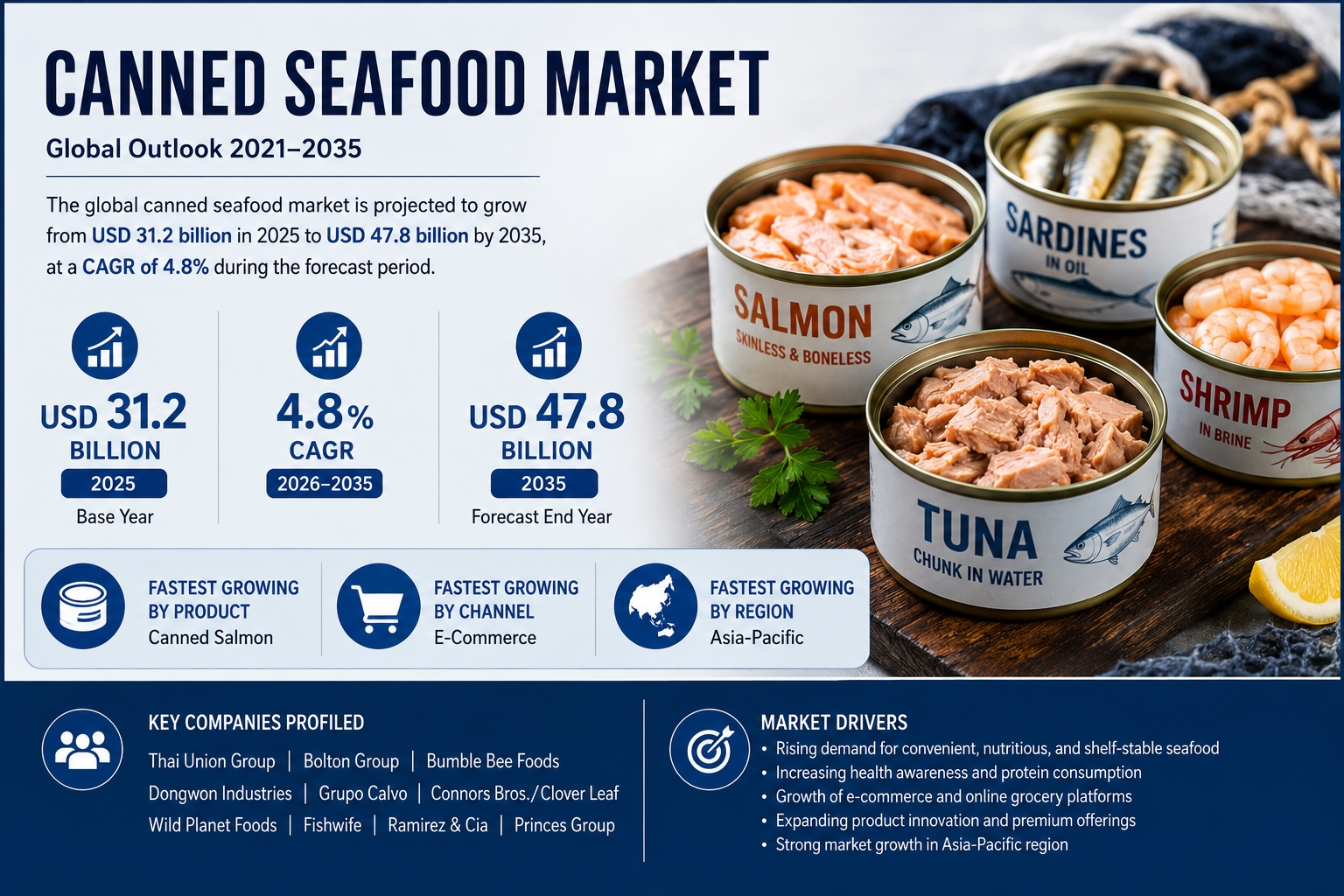
NEW YORK, NY, UNITED STATES, July 10, 2026 /EINPresswire.com/ -- The global canned seafood market is entering a new phase of expansion as consumers, retailers, and food service operators increasingly prioritize convenient, shelf-stable, and protein-rich meal solutions. According to the latest market outlook, the global canned seafood market was valued at USD 31.2 billion in 2025 and is projected to reach USD 47.8 billion by 2035, advancing at a compound annual growth rate of 4.8% during the forecast period from 2026 to 2035.— Market Research Future (MRFR)
Market Overview
The market includes canned tuna, salmon, sardines, mackerel, shrimp, and other preserved seafood products that continue to hold strong appeal across both developed and emerging economies. Rising consumer interest in quick-preparation meals, expanding retail penetration, stronger e-commerce adoption, and the growing preference for long shelf-life pantry staples are all supporting the market’s steady upward trajectory. The report also identifies canned salmon as the fastest growing product segment, e-commerce as the fastest growing distribution channel, and Asia-Pacific as the fastest growing regional market.
The study period for the market spans 2021 to 2035, reflecting a long-term view of how consumer behavior, supply chain modernization, and product innovation are reshaping the category. As households continue to seek practical meal solutions that balance nutrition, affordability, and convenience, canned seafood is becoming increasingly relevant in everyday diets and pantry planning.
Get Full PDF Sample Copy of Report: (Including Full TOC, List of Tables & Figures, Chart) @ https://www.marketresearchfuture.com/sample_request/6703
Changing Consumer Preferences
Canned seafood has long held a stable position in the global food landscape, but its role is evolving. Once viewed primarily as a budget-friendly pantry item, canned seafood is increasingly being repositioned as a practical, nutritious, and versatile source of protein for health-conscious households. As consumer expectations change, manufacturers are responding with cleaner labels, improved sourcing transparency, premium packaging, flavor innovation, and more differentiated product offerings. These changes are helping canned seafood compete not only with traditional shelf-stable foods but also with fresh and frozen seafood options.
Consumers are also becoming more selective about the foods they buy. They want products that are easy to store, simple to prepare, and aligned with broader wellness goals. Canned seafood fits this demand because it offers a combination of convenience and nutritional value that is difficult for many other packaged foods to match. In addition, the category benefits from strong familiarity and repeat purchasing behavior, which supports long-term market stability.
Key Growth Drivers
One of the strongest growth drivers in the market is convenience. Modern consumers continue to place a premium on foods that reduce preparation time without sacrificing nutrition. Canned seafood fits this demand particularly well because it offers ready-to-eat or easy-to-prepare meal applications for salads, sandwiches, pasta dishes, rice bowls, crackers, soups, and snacks. It also provides a reliable protein source for consumers managing busy schedules, households seeking affordable meal options, and individuals looking to build pantry reserves for emergency preparedness or long-term storage.
Another important driver is the growing demand for affordable protein. As food inflation and household budget pressures continue to influence purchasing decisions, canned seafood offers a practical value proposition. It is widely available, easy to portion, and suitable for a broad range of recipes. This makes it attractive to families, students, working professionals, and older consumers alike. The ability to deliver protein at a relatively accessible price point is one of the category’s most enduring strengths.
Nutritional value is another key reason behind the market’s momentum. Seafood is widely recognized for its protein content, omega-3 fatty acids, and essential nutrients, and canned formats make these benefits accessible in a convenient shelf-stable form. As consumers become more label-conscious and nutrition-focused, products that combine convenience with recognized health benefits are gaining stronger shelf presence. Canned salmon, in particular, is benefiting from this trend because it is often associated with premium nutrition, broad culinary versatility, and strong consumer trust. In many markets, salmon is increasingly perceived as a higher-value canned seafood option with room for brand differentiation and premium pricing.
Product Segment Insights
Among product categories, canned salmon is emerging as the fastest growing segment. This growth is supported by rising consumer awareness of salmon’s nutritional profile, its premium image, and its suitability for both everyday meals and elevated recipes. Canned salmon is increasingly being used in salads, patties, spreads, grain bowls, and ready-to-eat meal kits, making it a versatile choice for modern consumers.
Canned tuna remains one of the most established and widely consumed products in the category, supported by strong brand recognition and broad retail availability. Sardines and mackerel continue to attract consumers seeking nutrient-dense, affordable seafood options, while canned shrimp and other preserved seafood products are gaining traction in specialty and premium segments. The diversity of product offerings is helping the market serve a wider range of tastes, price points, and dietary preferences.
Distribution Channel Trends
Retail channel transformation is also reshaping the market. Supermarkets and hypermarkets continue to account for a substantial share of canned seafood sales, but e-commerce is emerging as the fastest growing channel. Online grocery shopping, direct-to-consumer sales, subscription pantry services, and marketplace-based food retailing are making canned seafood easier to discover and purchase. This shift is especially important for niche and premium brands that may not have extensive physical shelf space in traditional retail environments. Digital channels also allow companies to communicate sourcing credentials, sustainability practices, ingredient transparency, and recipe ideas more effectively than conventional shelf labels alone.
The rise of e-commerce is particularly significant for premium canned seafood brands. Consumers buying online are often more willing to explore artisanal, organic, wild-caught, or specialty options. As a result, brands are using digital platforms to highlight the provenance of seafood, production methods, certifications, and taste profiles. Packaging designed for delivery, multi-pack bundles, variety packs, and curated product assortments are also becoming more common as companies adapt to changing shopping habits. In a market where convenience is important, online access has become an additional form of convenience that can accelerate purchasing decisions and improve brand loyalty.
Regional Outlook
Regionally, Asia-Pacific stands out as the fastest growing market for canned seafood. The region’s growth is supported by a combination of population scale, urbanization, evolving dietary habits, rising middle-class spending, and strong seafood consumption traditions in several countries. Local and international manufacturers alike are focusing on this region because of the opportunity to serve both mass-market and premium consumer segments. Asia-Pacific also benefits from strong production ecosystems, established seafood supply chains, and increasing retail modernization, all of which support market expansion.
North America and Europe remain important mature markets, but growth in these regions is increasingly influenced by product premiumization, sustainability concerns, and innovation in flavor and packaging. Consumers in these markets are more likely to seek ethically sourced seafood, traceable supply chains, and items with reduced additives or cleaner formulations. At the same time, they continue to value affordability, which keeps canned seafood highly relevant in a period of fluctuating food prices and consumer pressure on household budgets. The ability to deliver both value and quality is one of the sector’s most important competitive advantages.
Latin America and the Middle East and Africa are also expected to contribute to long-term market expansion as retail infrastructure improves and consumer access to packaged seafood broadens. In these regions, shelf-stable seafood products are increasingly valued for their practicality, storage benefits, and suitability for urban households and remote distribution networks.
Sustainability and Product Innovation
The canned seafood market is also shaped by broader food industry trends, including sustainability and responsible sourcing. Seafood buyers are paying closer attention to fishing practices, environmental impact, certifications, and the long-term resilience of marine resources. Brands that can demonstrate responsible sourcing, traceability, and stewardship of supply chains are likely to build stronger trust among consumers and retail partners. Sustainability has moved beyond a marketing message and is increasingly becoming a business requirement, especially for companies targeting premium shelves and international expansion.
Innovation in packaging is contributing to market resilience as well. Easy-open cans, recyclable materials, single-serve portions, stackable containers, and visually appealing labels are helping brands modernize the canned seafood aisle. Packaging design now plays a larger role in consumer perception, especially where premiumization is involved. A product that looks fresh, modern, and responsibly produced can gain stronger attention even in a category that has historically relied on functional, utilitarian packaging. As competition intensifies, visual identity and packaging convenience are becoming important differentiators.
Manufacturers are also investing in flavor innovation, seasoning variations, and ready-to-eat meal formats to appeal to younger consumers and busy households. These developments are helping canned seafood move beyond traditional pantry use and into more contemporary eating occasions. As a result, the category is becoming more dynamic and more closely aligned with broader trends in convenience food and healthy snacking.
Competitive Landscape
The report profiles major companies shaping the competitive landscape, including Thai Union Group, Bolton Group, Bumble Bee Foods, Dongwon Industries, Grupo Calvo, Connors Bros./Clover Leaf, Wild Planet Foods, Fishwife, Ramirez & Cia, and Princes Group. These companies represent a broad spectrum of market strategies, from scale-driven global distribution to premium branding and niche positioning. Some players are emphasizing value and reach, while others are focusing on sustainability, sourcing transparency, and elevated product experiences. This mix of business models reflects the diversity of consumer demand in the category.
Thai Union Group and Bumble Bee Foods continue to represent the influence of large-scale seafood processing and distribution. Bolton Group, Dongwon Industries, Grupo Calvo, Connors Bros./Clover Leaf, Ramirez & Cia, and Princes Group also play key roles in maintaining established brand recognition and retail penetration in regional and global markets. At the same time, premium and emerging brands such as Wild Planet Foods and Fishwife illustrate how product storytelling, quality positioning, and ingredient transparency can open new growth opportunities within a mature category. Their presence demonstrates that canned seafood is no longer limited to commodity-style competition alone.
Market Opportunities Ahead
The market outlook also suggests that consumer education will matter more in the years ahead. Many shoppers are now making more deliberate decisions about protein sources, meal planning, and pantry stocking. Brands that explain product benefits clearly, provide recipe inspiration, and connect canned seafood to healthier everyday eating occasions are better positioned to capture demand. Educational content, digital marketing, social media storytelling, and retail partnerships may become just as important as product formulation itself. In this environment, the most successful brands will likely be those that combine quality, convenience, credibility, and digital visibility.
Another factor supporting the market is the enduring appeal of affordable protein. As households continue to balance budget concerns with nutrition goals, canned seafood offers a compelling value proposition. It can be stored for long periods, used in multiple meal formats, and purchased in a range of price points. This flexibility gives the category resilience even when consumer spending becomes more cautious. The combination of long shelf life and broad meal utility makes canned seafood one of the more practical protein options on the shelf.
Looking ahead, the global canned seafood market is expected to benefit from a balance of traditional demand and new consumer behaviors. The category’s established place in household pantries provides stability, while product upgrades, online distribution, sustainability initiatives, and premium brand growth provide additional momentum. The forecast period through 2035 is likely to be defined by greater segmentation, more sophisticated branding, and sharper competition across both mainstream and premium offerings. Companies that adapt to these shifts are expected to capture the greatest share of future growth.
A market analyst at Market Research Future commented, “Canned seafood is no longer just a convenience item. It is becoming a strategic category where nutrition, sustainability, premiumization, and digital retail all intersect. Brands that can deliver on transparency, taste, and accessibility will be best positioned to lead the next stage of market growth.”
The same analyst added, “Canned salmon, e-commerce, and Asia-Pacific are particularly important growth signals because they reflect where consumer preferences and distribution models are moving. The market is growing steadily, but the winners will be the companies that understand how to connect functional value with modern consumer expectations.”
As the market expands from USD 31.2 billion in 2025 to a projected USD 47.8 billion by 2035, canned seafood is set to remain a meaningful and adaptable segment within the global food industry. Its appeal rests on a rare combination of affordability, convenience, nutrition, and shelf stability, all of which remain highly relevant in a changing consumer environment. With continued innovation across products, channels, and geographies, the category is positioned for sustained global relevance over the next decade.
Discover Related Research Reports By Market Research Future:
Canned Tuna Market
https://www.marketresearchfuture.com/reports/canned-tuna-market-10335
Canned Salmon Market
https://www.marketresearchfuture.com/reports/canned-salmon-market-24351
Seafood Processing Market
https://www.marketresearchfuture.com/reports/seafood-processing-market-8612
Sagar Kadam
Market Research Future
+1 628-258-0071
email us here
Legal Disclaimer:
EIN Presswire provides this news content "as is" without warranty of any kind. We do not accept any responsibility or liability for the accuracy, content, images, videos, licenses, completeness, legality, or reliability of the information contained in this article. If you have any complaints or copyright issues related to this article, kindly contact the author above.
