

Premium Quality Marble Cutting Blade Factory: WANLONG's Systematic Diamond Tool Manufacturing Approach
These frequent micro-interruptions disrupt production schedules and increase material waste. Overcoming these variations requires a deeper look into tool engineering, specifically how specialized diamond tools are formulated and manufactured. As a Premium Quality Marble Cutting Blade Factory, Wanlong Times Technology Co., Ltd. addresses these exact mechanical challenges through systemic metallurgical research and strict, data-driven manufacturing processes.
Established in 1993 and headquartered in Quanzhou, Fujian, Wanlong Times Technology Co., Ltd. (Wanlong Group) is a high-tech enterprise specializing in diamond tools, stone machinery, and composite stone panels. By integrating R&D with advanced manufacturing across two industrial parks covering 64 acres and 40,000 square meters of facilities, WANLONG is committed to advancing the high-end development of the stone processing industry. Guided by its mission of "making cutting easier," the company operates a leading stone sample analysis laboratory that delivers precise technical adjustments. This background allows the company to develop marble cutting tools that specifically counteract the vulnerabilities of soft and brittle stone materials.
Defining the Premium Standards of Marble Cutting Blades
Unlike harder igneous stones like granite, marble presents a unique mechanical paradox. It is relatively soft and abrasive, yet highly prone to fractures and edge chipping along its natural veins. Standard, generalized diamond blades often fail to balance these traits, either dulling too quickly or generating excessive friction that cracks the stone. WANLONG addresses this by implementing a distinct differentiation between marble and granite segment formulations within its core product design.
To maintain clean cuts on marble, a premium quality marble cutting blade relies on a custom copper-based matrix combined with carefully selected, coarse-grained diamonds. The copper-based bond wears away at a controlled rate, constantly exposing fresh, sharp diamond crystals to ensure rapid material removal without applying excessive mechanical pressure.
Furthermore, the structural integrity of the blade depends heavily on its manufacturing method. WANLONG utilizes vacuum brazed and advanced laser welding technologies to secure the diamond segments to the steel core. This ensures that the segments remain firmly attached under high-frequency operational vibrations, while preventing any thermal deformation of the core. The result is a highly stable tool that preserves straight cutting trajectories over long production shifts.
The End-to-End Quality Control Architecture
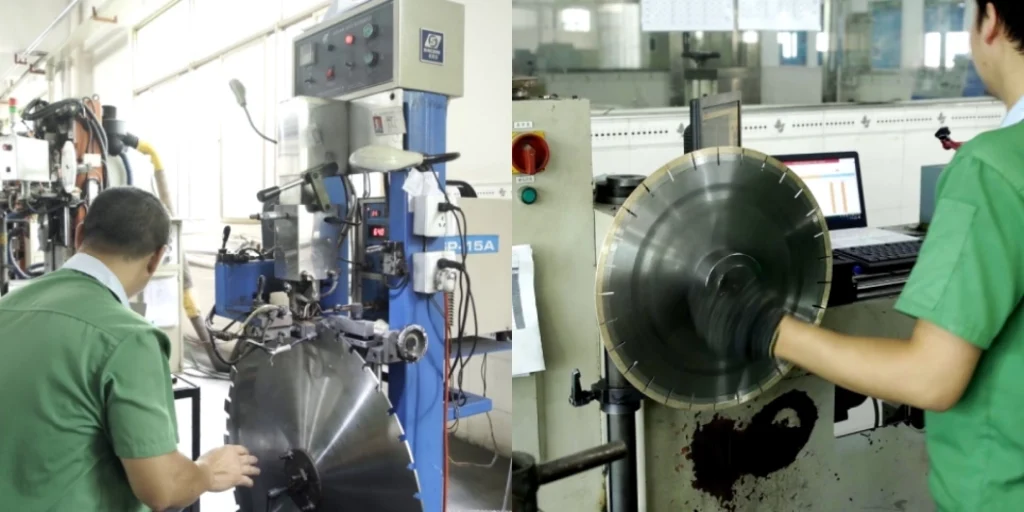
Achieving consistent tool performance across thousands of production cycles requires a manufacturing process that minimizes human error and material variance. At the WANLONG production facilities, quality control is treated as an interconnected, multi-stage architecture that governs every phase of production, from raw powder selection to final mechanical testing.
● Incoming Material Analysis
The reliability of a diamond segment begins at the microscopic level. Before entering the production line, all diamond powders undergo strict particle size distribution testing to verify uniform crystal dimensions. Simultaneously, the metallic elements composing the matrix bond undergo elemental analysis to confirm purity and composition. This precise sorting guarantees that every batch of raw materials aligns exactly with the engineered formulation for marble processing.
● Precision In-Process Control
Once the materials are approved, they move to the automated cold-pressing and mixing stations. WANLONG utilizes high-precision automated cold-pressing machinery to compress the powder mixtures into uniform segments. This automation ensures that each segment achieves an identical density profile, with weight tolerances strictly maintained within a variance of plus or minus 0.1 grams.
Following cold pressing, the segments are transferred to atmosphere-protected sintering furnaces. The sintering phase utilizes precisely calibrated computer temperature curves to apply heat and pressure without exposing the components to oxygen. This protective environment prevents the diamond crystals from undergoing graphitization—a thermal degradation process that weakens the diamond and reduces its cutting capability.
● Comprehensive Pre-Shipment Inspection
No blade leaves the factory floor without undergoing a rigorous physical validation sequence. Technicians subject the finished blades to static balance testing, hardness verifications, and strict runout inspections, measuring both radial and axial runout. This ensures that the blade remains perfectly concentric when spinning at high speeds.
Finally, random samples from each production batch undergo practical cutting trials on actual stone blocks. These live tests verify that the blade maintains its target cutting efficiency and keeps the stone edge chipping rate within acceptable industrial limits before shipping to global markets.
This multi-stage quality control architecture differentiates WANLONG's manufacturing approach from conventional blade production methods commonly found across the industry. A closer look at each critical production parameter reveals how this systematic process directly impacts final product consistency and field performance.
Data-Driven Performance and Structural Benefits
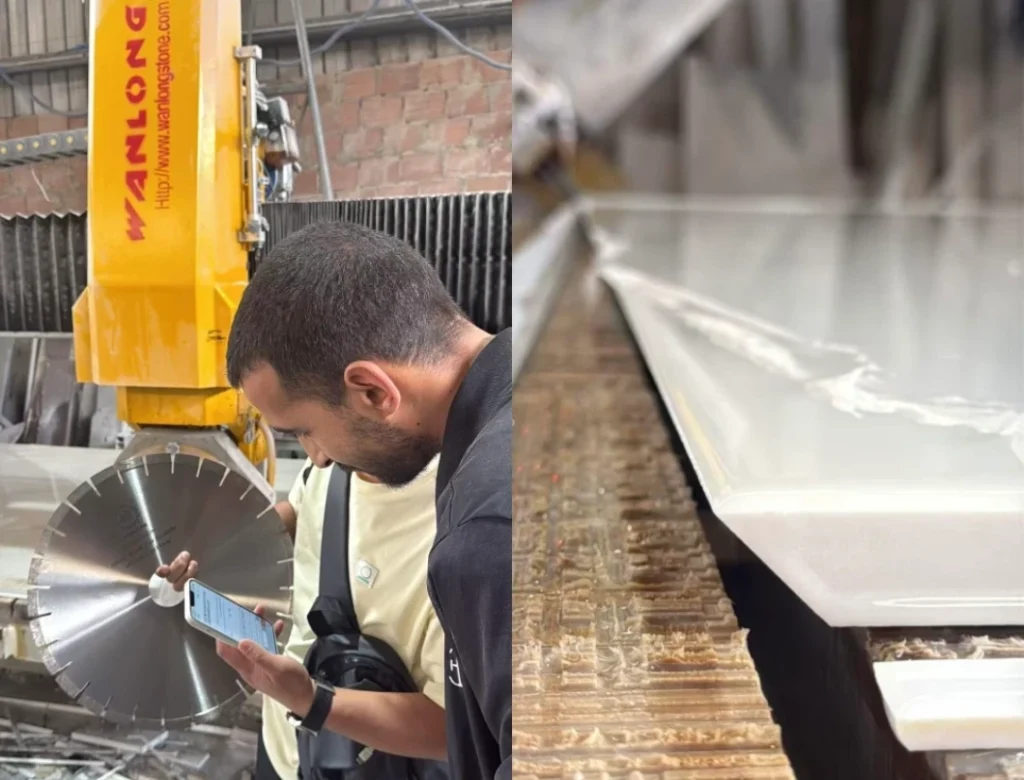
In a commercial processing workshop, the value of a diamond blade is measured by its impact on the overall workflow. Blades produced by WANLONG are engineered to deliver a clean, smooth cut on the first pass. By eliminating micro-fractures along the cutting line, these blades preserve the structural integrity of the slab edges. This precise performance significantly reduces the need for secondary grinding or remedial edge polishing, allowing workshops to optimize their material yield and accelerate throughput.
This operational efficiency is further supported by the longevity of the tools. Feedback from stone fabricators operating under continuous, high-volume marble cutting conditions shows that these blades maintain their cutting sharpness and structural shape over extended lifespans compared to standard alternatives. This wear resistance directly translates into fewer tool changes and reduced machine downtime.
Integrated Mechanical and Technical Alignment
The performance of a premium cutting tool is deeply linked to the machinery operating it. Because WANLONG manufactures both diamond tools and advanced stone processing machinery—such as bridge cutters and polishing systems—the company possesses a comprehensive understanding of the mechanical forces at play during operation. This dual expertise enables the team to optimize the interaction between the blade's metallurgical composition and the machine's power delivery, feed speed, and spindle stability.
To support diverse production setups, WANLONG provides specialized selection support tailored to individual factory configurations. Technical teams analyze the specific machinery in use—whether manual cutting machines, heavy-duty bridge saws, or high-precision CNC centers—as well as the specific hardness and mineral composition of the marble being processed. This detailed assessment ensures that clients receive the optimal tool specifications for their specific equipment.
Furthermore, backed by an established regional service network, Wanlong Times Technology Co., Ltd. provides rapid technical consultations and comprehensive after-sales support to resolve operational issues quickly. This integrated approach ensures that stone processors can sustain high productivity, minimize material loss, and maintain reliable operations across a wide range of architectural and stone processing applications worldwide.
Wanlong Times Technology Co., Ltd.
Wanlong Times Technology Co., Ltd.
+86 595 2249 8030
email us here
Legal Disclaimer:
EIN Presswire provides this news content "as is" without warranty of any kind. We do not accept any responsibility or liability for the accuracy, content, images, videos, licenses, completeness, legality, or reliability of the information contained in this article. If you have any complaints or copyright issues related to this article, kindly contact the author above.
