

The USD 143 Billion Power Grid: Global EV Charging Station Market Set for 18.2% Annual Surge Through 2035
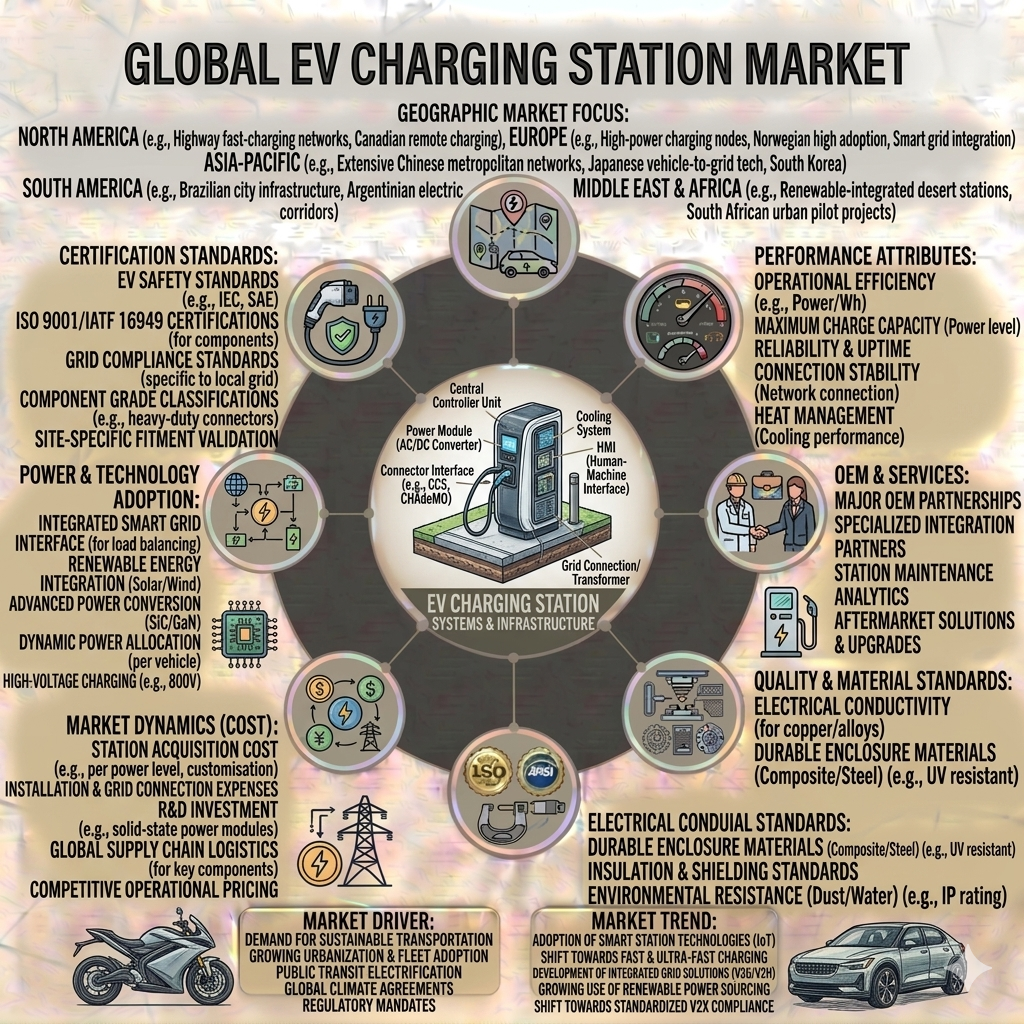
EV Charging Station Market
The global EV (electric vehicle) charging station market is projected to grow from USD 26.87 billion in 2025 to USD 143 billion by 2035
NEWARK, DE, UNITED STATES, April 2, 2026 /EINPresswire.com/ -- As the global transition to sustainable mobility reaches a critical mass, the infrastructure supporting the electric revolution is undergoing a massive industrial expansion. According to the latest 2026 strategic analysis, the Global EV Charging Station Market is valued at USD 26.87 billion in 2025 and is projected to skyrocket to USD 143 billion by 2035, expanding at a robust CAGR of 18.2%.
This growth trajectory is underpinned by a global "de-carbonization" mandate, where governments are pivoting from simple vehicle subsidies to massive infrastructure build-outs. The market is currently shifting from a fragmented network of slow chargers to a standardized, high-tech grid characterized by ultra-fast 350 kW+ outputs, wireless inductive technology, and AI-driven energy management.
The Intelligence Core: IoT and Sensor Integration
In 2026, a charging station is no longer just a plug; it is an intelligent edge-computing node. The integration of IoT and advanced sensors is redefining the sector by enabling real-time optimization and predictive maintenance.
• Thermal and Current Monitoring: High-power charging generates significant heat. Advanced sensors now monitor temperature and connector integrity in real time, preventing overheating and ensuring safety during rapid energy transfers.
• Predictive Maintenance: Industry leaders like ABB and Siemens are utilizing IoT-enabled remote diagnostics to detect wear and tear before a fault occurs. This shift from reactive to proactive service is drastically reducing downtime across public networks.
• Smart Grid & V2G: Modern stations now communicate directly with power grids. Through Vehicle-to-Grid (V2G) technology, charging stations can act as balancing tools, drawing power during off-peak hours and potentially feeding it back to the grid during periods of high stress, enhancing overall grid stability.
Get Access of Report Sample:
https://www.futuremarketinsights.com/reports/sample/rep-gb-16389
Segment Dominance: Private and Residential Charging Lead the Way
Despite the visibility of highway fast-chargers, the "Home and Work" charging model remains the dominant force in the market.
Private Charging Stations are expected to hold over 97% of the market share in 2025, continuing their dominance through the next decade. This segment is growing at an 18.3% CAGR, driven by the sheer convenience of home-based charging and the rollout of smart digital solutions that allow users to manage their energy consumption via mobile apps.
Similarly, the Residential Charging segment captures more than 94% of total volume. In mature markets like Norway, where EV adoption exceeds 90%, over 80% of owners rely on home charging. This behavior is being incentivized globally; for example, the USA offers a 30% federal tax credit for home installations, while the UK’s early adoption of smart charging regulations has made home-based energy management a standard consumer expectation.
Technological Breakthroughs: Wireless and Renewable Integration
The market is witnessing a move toward "invisible" infrastructure. Wireless Power Transfer (WPT) or inductive technology is emerging as a major trend, particularly in urban environments and autonomous taxi fleets. By eliminating physical cables, companies like WiTricity and ChargePoint are streamlining the user experience and reducing the maintenance costs associated with heavy cabling.
Furthermore, the "Green-to-Green" concept is becoming a reality. Operators are strategically integrating on-site solar and wind power systems with battery storage. This allows charging stations to operate independently of the grid during peak demand, optimizing resource utilization and ensuring that the electricity powering the "zero-emission" vehicle is truly carbon-neutral.
Regional Powerhouses: China and Japan Drive Momentum
The geography of the charging market is a map of aggressive urbanization and legislative ambition.
Region/Country Projected CAGR (2025–2035)
The global EV charging station market is characterized by aggressive regional expansion, led by Japan with a projected 19.0% CAGR as the government pursues carbon neutrality by 2050 and a massive infrastructure target of 300,000 charging points by 2030. The United States follows closely at an 18.7% CAGR, supported by a USD 7.5 billion federal investment aimed at establishing a national network of 500,000 stations. In the United Kingdom, an 18.2% CAGR is driven by the early adoption of smart charging regulations and a focus on high-density urban infrastructure projects. Germany is expected to expand at a 17.7% CAGR, leveraging its robust automotive industry and a USD 1.1 billion subsidy program dedicated to household charging solutions. Finally, China maintains a steady 17.3% CAGR, solidifying its position as the world's largest NEV ecosystem while currently holding 85% of all global fast-charger installations.
Competitive Landscape: The Era of OEM Partnerships
The market is moderately fragmented, with Tier-1 players like Tesla, ABB, BYD, and Schneider Electric capturing approximately 50-60% of the value pool. A significant new trend is the entry of traditional automakers (OEMs) into the charging infrastructure space to control the total user experience.
Recent strategic alliances, such as the joint venture between BMW, GM, Honda, Hyundai, and Stellantis, aim to deploy 30,000 high-speed charging stations across North America by 2030. These stations will utilize the "Plug and Charge" standard, allowing vehicles from various brands to authenticate and pay automatically, mirroring the seamless experience pioneered by Tesla’s Supercharger network.
Frequently Asked Questions (FAQ)
1. Is "Range Anxiety" still a valid concern for EV buyers?
The industry is aggressively addressing this through "Fast-Charging Corridors." With chargers now being installed every 25-50 km on major highways in the US, Europe, and India, long-distance travel is becoming as reliable as traditional ICE vehicle trips.
2. Why is home charging growing so much faster than public charging?
Home charging is significantly more cost-effective and convenient. It allows owners to "refuel" overnight during off-peak hours when electricity rates are lower, essentially turning a parking spot into a private gas station.
3. What is Vehicle-to-Grid (V2G) technology?
V2G allows an electric vehicle to not only draw power from the grid but also give it back. During peak hours or power outages, your car can act as a giant battery for your home or the city's power grid, helping to prevent blackouts.
4. How fast can "Ultra-Fast" chargers actually charge a car?
Current 350 kW ultra-fast chargers can add roughly 200 miles (320 km) of range in about 15 to 20 minutes, depending on the vehicle's battery architecture. This brings the "refueling" experience closer to the time spent at a traditional gas station.
5. Are wireless charging stations safe?
Yes. Inductive charging uses electromagnetic fields to transfer energy between a ground pad and a vehicle pad. It is designed with safety sensors that automatically shut off the power if a foreign object (like a pet or metal tool) is detected between the pads.
Browse More Industry Reports :
EV Charging Cable Market
https://www.futuremarketinsights.com/reports/ev-charging-cables-market
EV Charging As A Service Market
https://www.futuremarketinsights.com/reports/ev-charging-as-a-service-market
EV Charging Cable Locks and Security Devices Market
https://www.futuremarketinsights.com/reports/ev-charging-cable-locks-and-security-devices-market
Sudip Saha
Future Market Insights Inc.
+1 347-918-3531
email us here
Legal Disclaimer:
EIN Presswire provides this news content "as is" without warranty of any kind. We do not accept any responsibility or liability for the accuracy, content, images, videos, licenses, completeness, legality, or reliability of the information contained in this article. If you have any complaints or copyright issues related to this article, kindly contact the author above.
