

Study Shows Small Businesses May Benefit From Comparing Health Funding Alternatives at Renewal

Analysis comparing six-year cumulative costs across fully insured, self-funded, level-funded, captive insurance, PEO, and Taft-Hartley trust models for small and mid-size employers.
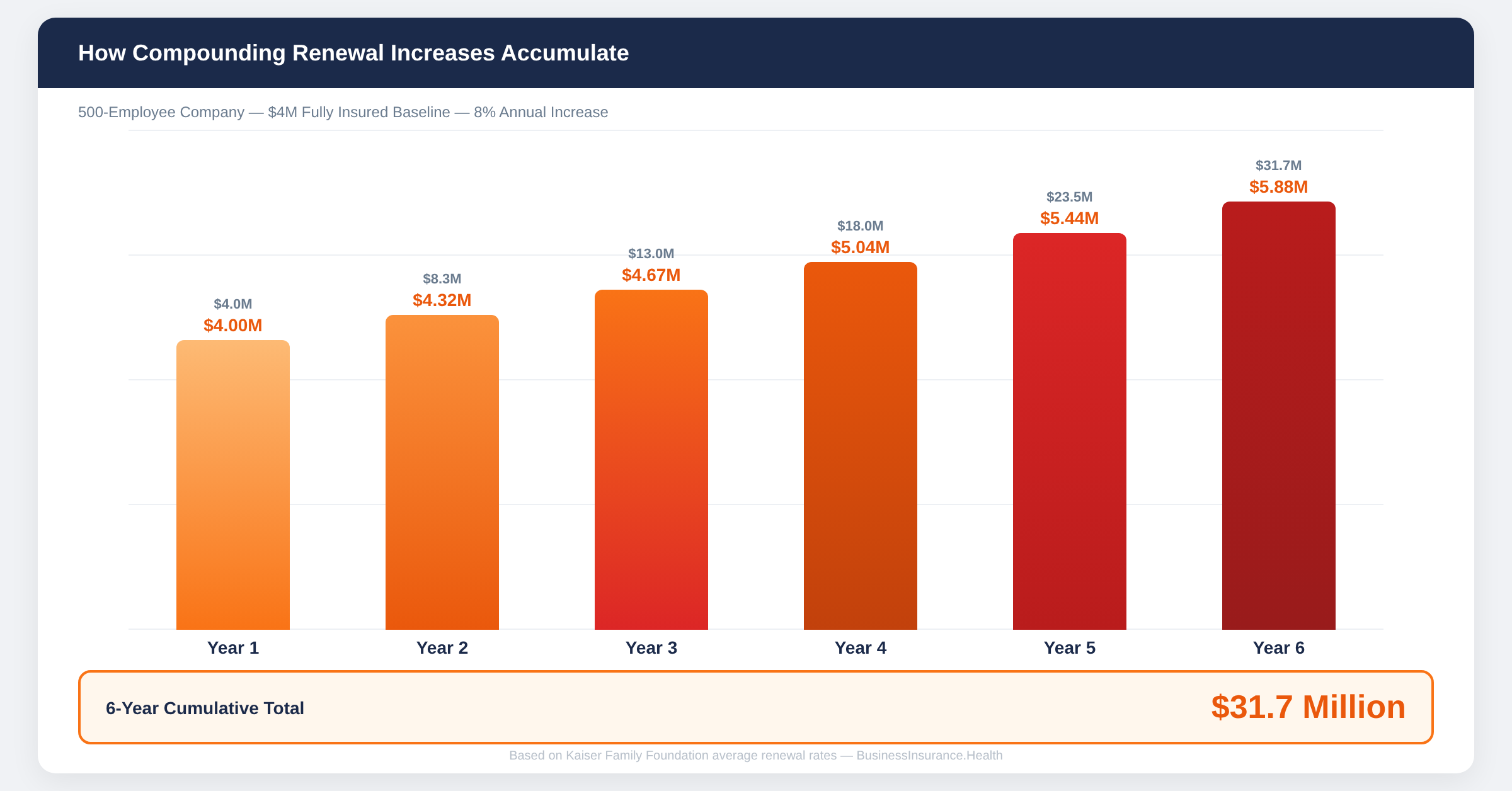
Illustration of how an 8 percent average annual renewal increase on a $4 million fully insured baseline compounds to approximately $31.7 million in cumulative costs over six years.
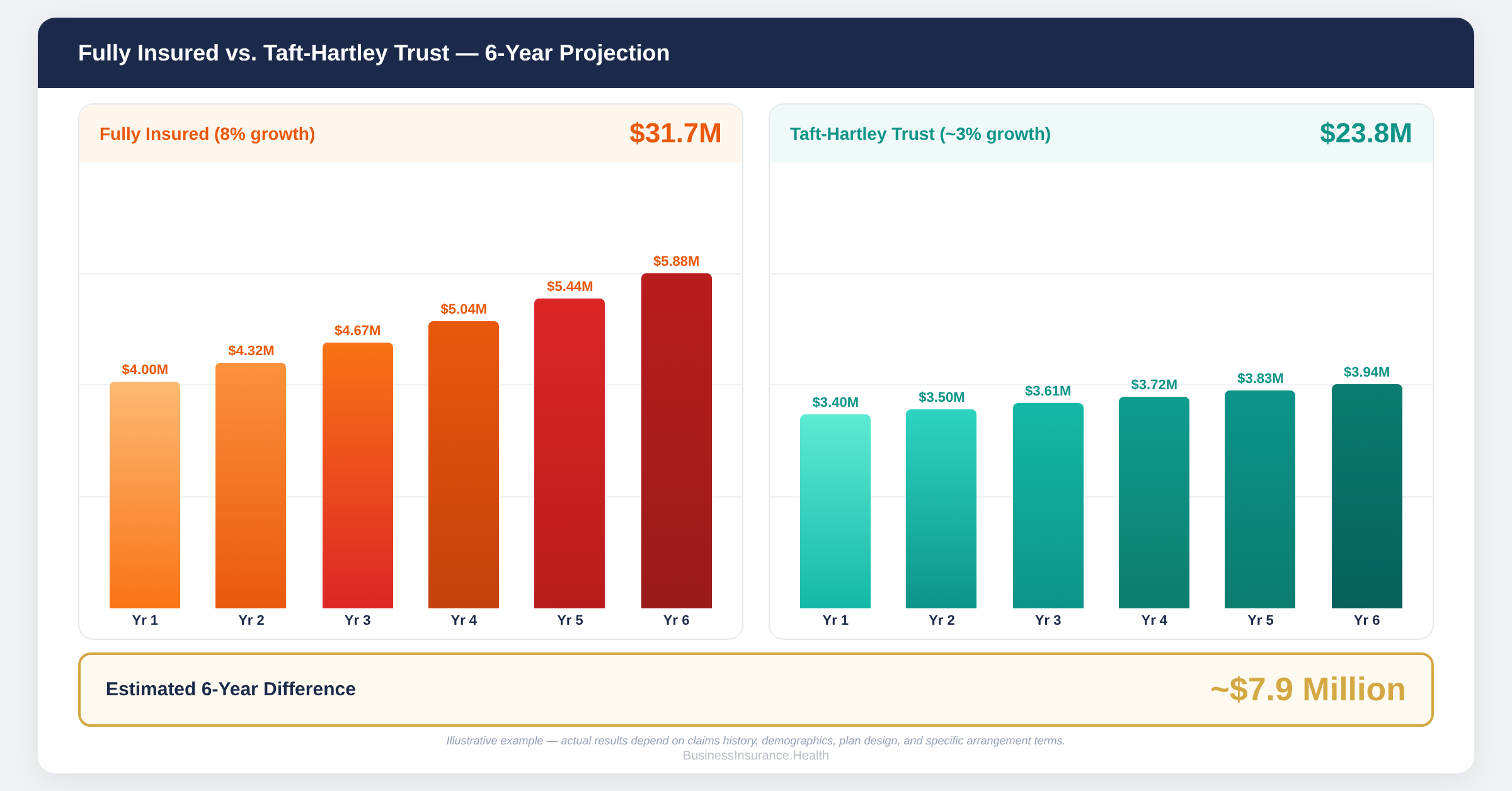
Side-by-side six-year cost projection comparing fully insured premiums at 8 percent annual growth to a Taft-Hartley trust alternative at approximately 3 percent annual growth, showing an estimated cumulative difference of $7.9 million.
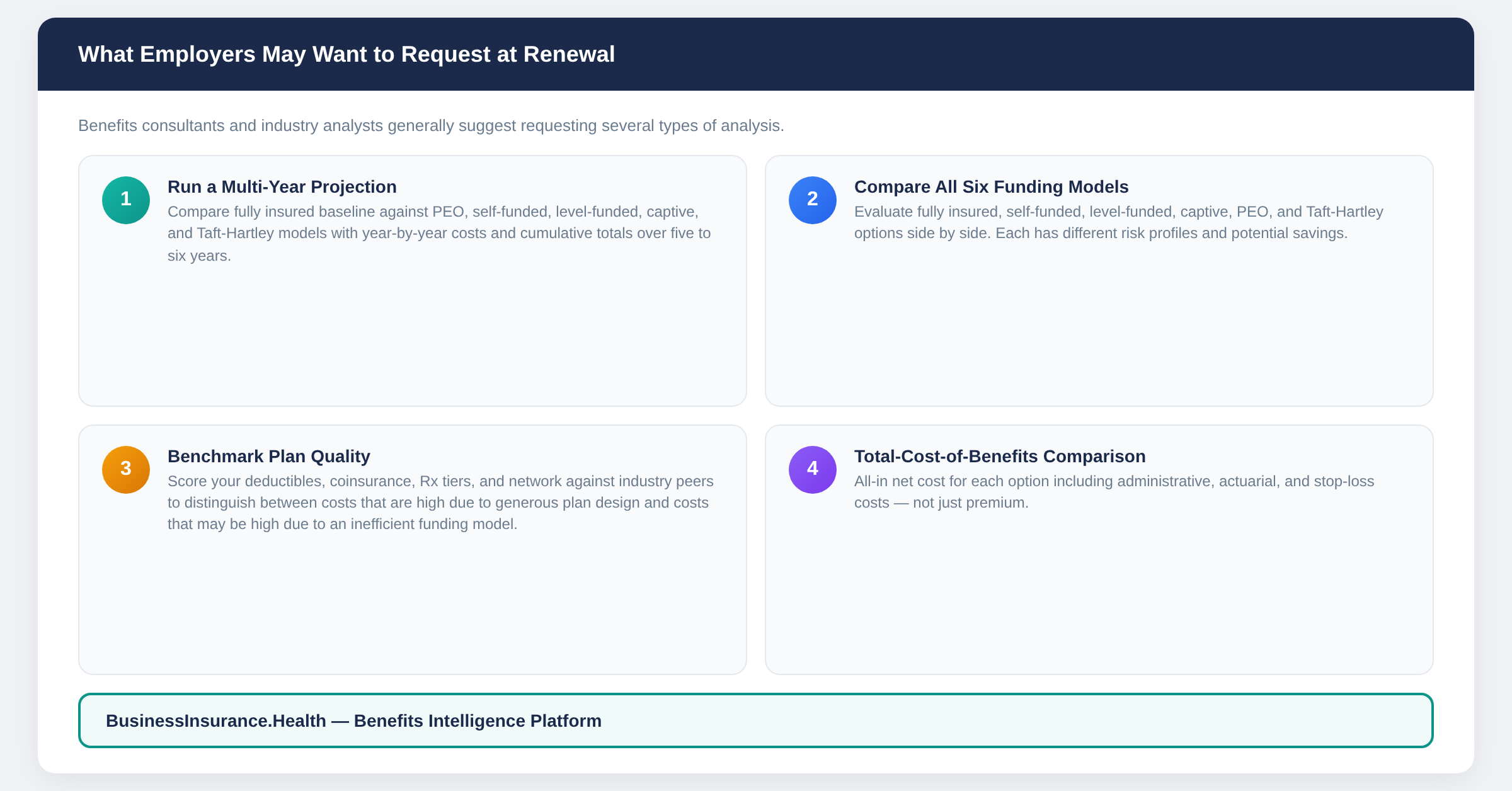
Summary of key analyses employers may want to request at renewal, including multi-year cost projections, total-cost-of-benefits comparisons, and peer benchmarking.
Sam Newland, CFP, founder of PEO4YOU and Business Insurance Health, on the value of multi-year cost projections for employers evaluating health funding alternatives at renewal.
Analysis of six-year cost projections suggests that employers who compare all funding models at renewal may identify significant savings opportunities
BOSTON, MA, UNITED STATES, March 30, 2026 /EINPresswire.com/ -- As employer health insurance costs continue to rise, a growing number of small and mid-size businesses may be renewing fully insured health plans without evaluating the full range of available funding alternatives, according to an analysis published by Business Insurance Health (https://businessinsurance.health/).
The analysis suggests that employers who compare all major health funding models — including self-funded plans, level-funded arrangements, captive insurance, Professional Employer Organizations, and Taft-Hartley trusts — before signing a renewal may identify cost-reduction opportunities that compound significantly over time.
Industry Context
Employer-sponsored health insurance costs have risen steadily over the past decade. According to the Kaiser Family Foundation 2024 Employer Health Benefits Survey, average annual premiums for employer-sponsored family health coverage reached $25,572 in 2024, an increase of approximately 7 percent from the prior year. For small firms with fewer than 200 employees, premium increases have been particularly challenging, as these employers typically have less negotiating leverage with carriers than large groups.
The National Alliance of Healthcare Purchaser Coalitions reported in its 2024 benchmarking survey that employers projected an average health cost increase of 7.8 percent for the plan year. Meanwhile, the Mercer National Survey of Employer-Sponsored Health Plans found that total health benefit cost per employee rose 5.2 percent in 2023, the largest increase in over a decade.
Against this backdrop, alternative funding models — including self-funded plans, level-funded arrangements, captive insurance structures, and multi-employer trusts — have gained broader adoption among mid-market employers, according to the Employee Benefit Research Institute. These models may offer different cost dynamics than traditional fully insured plans, though they also carry different risk profiles and administrative requirements.
How Compounding Renewal Costs May Accumulate
The cumulative effect of annual renewal increases can be substantial when projected over multiple years. The following example illustrates how compounding affects total cost, using industry-average renewal rates.
Consider a 500-employee company with approximately $4 million in annual fully insured premiums. At an assumed average annual renewal increase of 8 percent — consistent with long-term industry averages reported by the Kaiser Family Foundation — projected cumulative costs over six years would be approximately $31.7 million.
By comparison, certain alternative funding models have historically experienced lower annual cost growth. Taft-Hartley multi-employer trusts, for example, have reported average annual increases closer to 3 percent in recent years, according to data from the International Foundation of Employee Benefit Plans. If the same employer were able to access a trust arrangement at an estimated 15 percent lower baseline — reflecting the pooling and actuarial efficiencies sometimes available through these structures — projected six-year cumulative costs could be approximately $23.8 million.
The estimated difference of approximately $7.9 million is illustrative and would depend on a range of factors including the employer's claims history, employee demographics, plan design, geographic location, and the specific terms of any alternative arrangement. However, the example suggests that the compounding effect of even modest annual savings can be material over time.
Why Employers May Not See All Options
Industry observers have noted that the health benefits market has historically operated with limited transparency around funding alternatives. Several structural factors may contribute to this dynamic.
First, the traditional fully insured market has been the default model for small and mid-size employers for decades, and many decision-makers may simply be unaware that alternative structures exist or are accessible to companies of their size. According to a 2023 report from the Employee Benefit Research Institute, awareness of alternative funding models among small employers remains relatively low.
Second, the evaluation of alternative funding models often requires actuarial analysis, census data modeling, and an understanding of stop-loss insurance, trust administration, and compliance requirements. This complexity may lead some advisors to default to fully insured recommendations as the most straightforward option for their clients.
Third, compensation structures in the benefits industry vary by funding model. Some advisors may receive different levels of compensation depending on the type of plan placed, which could influence which options are presented first or most prominently. Industry groups such as the National Association of Insurance Commissioners have advocated for greater compensation disclosure to address this concern.
These factors represent systemic dynamics rather than individual shortcomings. Many benefits advisors provide thorough, client-centered guidance. However, the combination of low employer awareness, analytical complexity, and variable compensation structures may result in some employers not seeing a complete comparison of available options at renewal.
What Employers May Want to Consider at Renewal
Benefits consultants and industry analysts generally suggest that employers approaching renewal may benefit from requesting several types of analysis.
A multi-year cost projection comparing the employer's current fully insured baseline against major alternatives — including PEO arrangements, self-funded plans (https://businessinsurance.health/self-funded/), level-funded plans (https://businessinsurance.health/level-funded-health-insurance-vs-fully-insured/), captive insurance, and Taft-Hartley trusts — with year-by-year costs, cumulative totals, and clearly stated assumptions. Projections covering at least five to six years may help illustrate the compounding effects discussed above.
A detailed summary of what each alternative funding model requires, including minimum employee thresholds, census data, actuarial costs, trust or captive setup costs, claims administration fees, stop-loss premiums, and ongoing compliance obligations. Each model carries different administrative requirements and risk exposures.
A peer benchmarking analysis — such as the one provided by the Benefits ROI Calculator (https://businessinsurance.health/benefits-roi-calculator/) — comparing the employer's current plan design, deductibles, coinsurance, and out-of-pocket maximums against industry and size cohort averages. This can help distinguish between costs that are high due to generous plan design and costs that may be high due to an inefficient funding model.
A total-cost-of-benefits analysis for each option, not limited to premium alone. Self-funded and alternative arrangements may carry additional administrative, actuarial, and stop-loss costs that should be compared on a net, all-in basis against the fully insured premium.
An Evolving Market
The health funding landscape for small and mid-size employers appears to be shifting. Technology platforms — such as the Premium Renewal Stress Test (https://businessinsurance.health/businessinsurance-stress-test/), Health Funding Cost Projector (https://businessinsurance.health/health-funding-projector/), and Benefits Savings Strategy Builder (https://businessinsurance.health/Benefits-Savings-Strategy-Builder/) — now enable employers to model renewal scenarios, compare funding alternatives, and access actuarial-grade projections that were previously available mainly through large consulting engagements. As these tools become more widely available, employer awareness of alternative funding models may continue to grow.
"The market is moving toward greater transparency in how health funding options are presented to employers," said Sam Newland, CFP, founder of PEO4YOU (https://peo4you.com/) and Business Insurance Health. "When employers have access to multi-year cost projections across all major funding models, they are better positioned to make informed decisions at renewal. That benefits everyone in the system."
ABOUT PEO4YOU / BUSINESS INSURANCE HEALTH
PEO4YOU, in partnership with Business Insurance Health, is a Boston-based independent benefits consulting firm founded by Sam Newland, CFP. The firm provides coverage in Texas (https://peo4you.com/texas-health-plan/) and nationwide (https://peo4you.com/nationwide-health-plan-coverage/), helping small and mid-size employers access enterprise-level benefits, HR support, and cost-reduction strategies through PEOs, self-funded and level-funded health plans, captive insurance, and Taft-Hartley trusts. Its Benefits Intelligence Platform at businessinsurance.health provides employers with actuarial-grade modeling tools. PEO4YOU is part of the Newland Group Insurance family of companies and contributes to a medical debt forgiveness initiative with every client engagement.
SAMUEL DAVID NEWLAND
PEO4YOU
+1 857-255-9394
email us here
Visit us on social media:
LinkedIn
Instagram
Facebook
YouTube
X
Legal Disclaimer:
EIN Presswire provides this news content "as is" without warranty of any kind. We do not accept any responsibility or liability for the accuracy, content, images, videos, licenses, completeness, legality, or reliability of the information contained in this article. If you have any complaints or copyright issues related to this article, kindly contact the author above.
