

Electrifying Urban Arteries: Global Trolley Bus Market to Reach USD 6.1 Billion by 2036
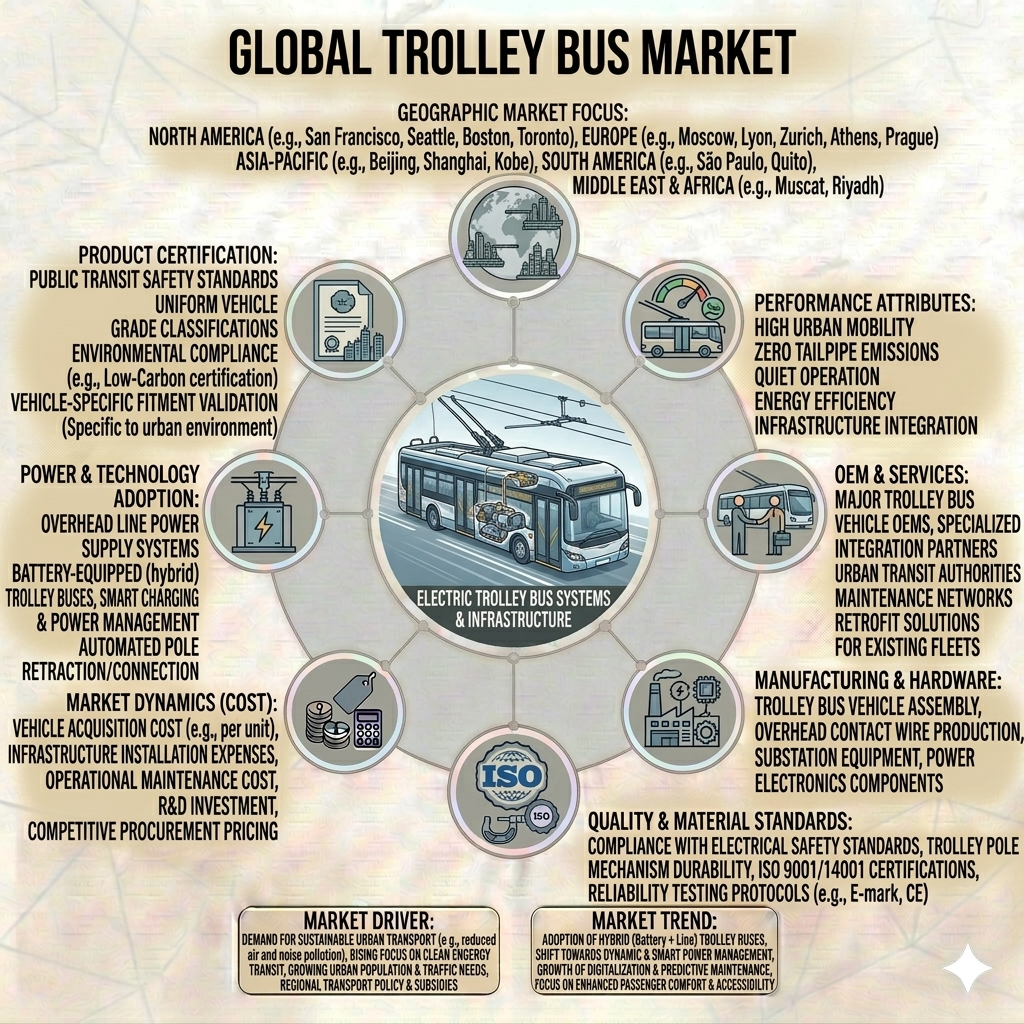
Trolley Bus Market Outlook
Revenue from trolley bus procurement is anticipated to surge at a considerable CAGR of 5.1% through 2036, elevating total market worth to USD 6.1 billion.
NEWARK, DE, UNITED STATES, March 30, 2026 /EINPresswire.com/ -- The global push for zero-emission transit is revitalizing one of the world’s most reliable electric transport modes. According to the latest 2026 strategic analysis, the Global Trolley Bus Industry is valued at USD 3.7 billion in 2026 and is projected to climb to USD 6.1 billion by 2036, growing at a CAGR of 5.1%.
This resurgence is driven by the evolution of the "Hybrid Trolley." Modern systems are no longer tethered strictly to overhead wires; instead, they utilize advanced battery backup systems and regenerative braking to navigate off-wire sections, offering municipal authorities unprecedented route flexibility while maintaining the high capacity of traditional electric transit.
Segmental Leadership: High Capacity and Public Utility
The market is currently defined by a preference for large-scale, efficient configurations designed to serve as the backbone of metropolitan transit.
• Articulated Dominance (56.3% Share): Articulated trolley buses lead the vehicle type segment. Their superior passenger flow and reduced energy consumption per rider make them the ideal choice for high-demand urban corridors and Bus Rapid Transit (BRT) applications.
• The 18-Meter Standard (52.1% Share): The 18-meter configuration has emerged as the industry "sweet spot," providing the perfect balance between high passenger capacity and the maneuverability required to navigate existing city street networks.
• Public Transit Focus (78.4% Share): Municipal transportation agencies remain the primary buyers. These organizations are leveraging federal climate action grants and public-private partnerships to transition aging diesel fleets into integrated, smart-grid-connected electric networks.
Get Access of Report Sample:
https://www.futuremarketinsights.com/reports/sample/rep-gb-6773
Regional Growth: Europe and Asia Lead the Charge
The global trolley bus market is experiencing varied growth patterns driven by specific national climate and infrastructure policies. China is projected to lead the market with a 6.4% CAGR, fueled by massive urbanization, strict air pollution mandates, and its global leadership in battery technology. Russia follows at 5.8%, where growth is centered on the modernization and fleet renewal of its extensive existing overhead wire networks. In Switzerland, a 4.9% CAGR is supported by the deep integration of renewable energy into public transit and high domestic sustainability standards. Germany is expected to expand at 4.6%, driven by federal decarbonization policies and the presence of major vehicle manufacturers. Finally, Canada projects a 4.1% CAGR, leveraging federal climate commitments and its specialized operational expertise in maintaining electric transit performance during extreme cold-weather conditions.
The Competitive Landscape: Beyond the Vehicle
The market is evolving from a simple hardware supply model to a "Full-Solution" delivery approach. Leading manufacturers are differentiating themselves by bundling vehicles with charging infrastructure, smart fleet management software, and long-term maintenance contracts.
• Solaris Bus & Coach SA and New Flyer Industries Inc. are currently leading the market by integrating vehicles with digital diagnostics and depot power management.
• BYD Company Ltd. and Škoda Electric a.s. are focusing on battery-assisted systems that allow for seamless transitions between wired and wireless operation.
• Other key innovators such as Van Hool NV, Hess AG, VDL Bus & Coach, and Irizar e-mobility are pushing the boundaries of lightweight articulation and autonomous driver-assistance features to improve safety and reliability.
Frequently Asked Questions (FAQ)
1. How do modern trolley buses differ from old ones?
Unlike traditional models that stopped if they disconnected from the wire, modern trolley buses are "In-Motion Charging" (IMC) vehicles. They carry onboard batteries that charge while driving under the wires, allowing them to detour around roadwork or extend routes into new neighborhoods without overhead infrastructure.
2. Are trolley buses better than standard battery-electric buses?
Trolley buses are often more efficient for high-frequency, heavy-duty routes. Because they draw power directly from the grid while moving, they don't need massive, heavy battery packs that take up passenger space or require long stationary charging times at the depot.
3. What is an "Articulated" trolley bus?
An articulated bus consists of two or more sections linked by a pivoting joint (the "accordion" section). This allows a longer vehicle—typically 18 meters or more—to carry significantly more passengers while still being able to turn corners on narrow city streets.
4. Why is Germany a key market for this technology?
Germany has some of the world's most stringent urban air quality laws. Many German cities already have the electrical substations needed for electric transit, making it cost-effective to modernize existing lines rather than starting from scratch with new technology.
5. How does regenerative braking work in a trolley bus?
When the bus slows down, the motor acts as a generator, converting the vehicle's kinetic energy back into electricity. This power can be stored in the onboard battery or even fed back into the overhead wires to power other buses on the same line, significantly reducing overall energy costs.
Browse More Industry Reports :
Europe Trolley Bus Market
https://www.futuremarketinsights.com/reports/europe-trolley-bus-market
Europe Trolley Bus Market Share Analysis
https://www.futuremarketinsights.com/reports/europe-trolley-bus-market-share-analysis
Business Jet Market
https://www.futuremarketinsights.com/reports/business-jet-market
Sudip Saha
Future Market Insights Inc.
+1 347-918-3531
email us here
Legal Disclaimer:
EIN Presswire provides this news content "as is" without warranty of any kind. We do not accept any responsibility or liability for the accuracy, content, images, videos, licenses, completeness, legality, or reliability of the information contained in this article. If you have any complaints or copyright issues related to this article, kindly contact the author above.
