

Updated Software Development Toolkit Further Enables Model-Based Enterprise
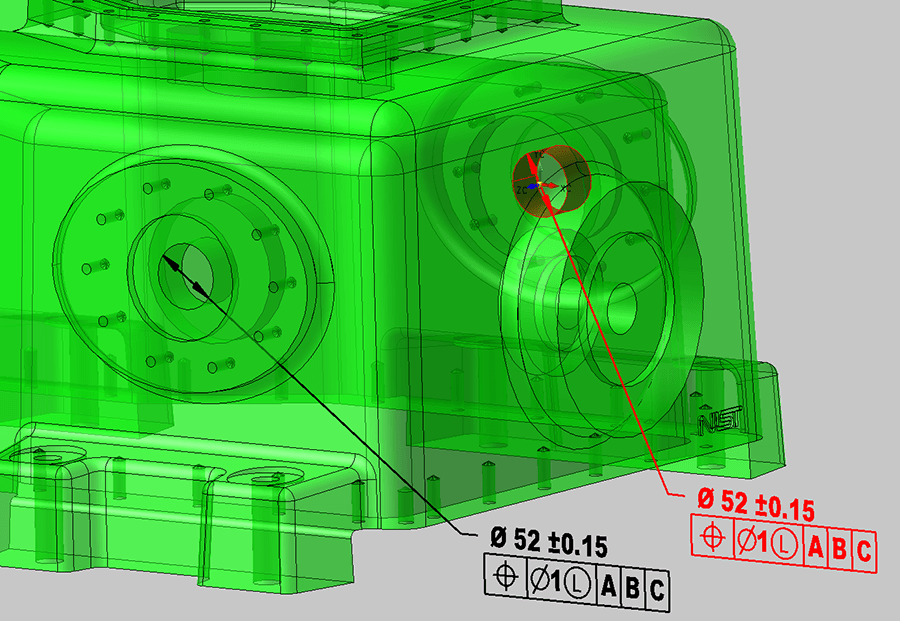
Separate inspection operations for each side of this part need their own annotations, with links automatically maintained to the original pattern tolerance definition
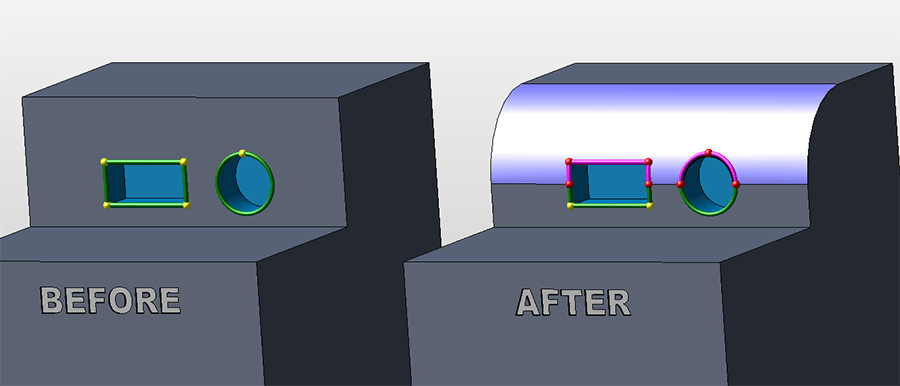
A blend on this simple test solid results in new or moved vertices, and new or moved edges (highlighted/enlarged) which the 8.0 kernel links to the original edges with persistent identifiers
Kubotek Kosmos Launches 8.0 Release of 3D Framework Software Components
Facilitating the Model-Based Enterprise with STEP AP242 Edition 4 and STEP XML
PERSISTENT IDENTIFIERS — The International Standards Organization (ISO) 10303 file formats, better known as STEP (Standard for the Exchange of Product model data), are the primary mechanism worldwide for sharing precise product data across engineering and manufacturing systems. Edition 4 of the newest application protocol 242 (AP242) for 3D engineering was published in 2025 and established a system for tagging data objects with persistent identifiers (ID) for traceability of product data across different manufacturing systems and suppliers. This traceability is essential for establishing a digital thread, a common pillar in Model-Based Enterprise initiatives, to ensure data quality and accountability, root-cause analysis of errors, and in some cases regulatory compliance. Complete persistent ID support has been incorporated into release 8.0 of the Kubotek Kosmos libraries allowing traceability of critical product data from proprietary CAD formats as it moves into standard STEP files used in various applications across manufacturing and inspection.
Through membership in the product data exchange consortium PDES since 2019, Kubotek Kosmos is an active participant in development, testing, and implementation of the STEP file formats. Aside from assisting in persistent ID projects, the Kosmos team has also implemented AP242 support for standard machined feature holes data (semantic holes) which are tagged to faces of the model.
SAVED VIEWS WITH CUTTING PLANE — To aid recipients in understanding a complex part, 3D product definitions commonly include saved view definitions containing camera orientation, zoom scale, and sets of annotations related to that view. These views are supported in the STEP AP242 standard and the 8.0 release expands toolkit support for such views which have been trimmed by a cutting plane to expose internal details. These limited views directly connected to the model meet a critical need in manufacturing which was formerly met with digitally disconnected drawings.
STEP XML — For 8.0 the Kosmos API also added support for reading STEP XML, the Part 28 STEP format for storage of complex product assemblies. STEP XML is commonly used for long term archiving of 3D product designs in Aerospace and Defense industries, in which some systems remain in service long after the software systems used to design them are deprecated.
“With 3D Framework 8.0, we continue our mission of empowering developers with the fastest, most interoperable geometric foundation available. Our expanded support for STEP AP242 Edition 4 and STEP XML directly reflects our involvement in global standards development. As a board member of PDES, Inc., I’ve seen firsthand how the evolution of these standards is enabling more reliable and efficient digital thread implementation across manufacturing. This release gives software teams the tools they need to fully participate in that transformation.”
— Ram Eswaran, CTO/COO, Kubotek Kosmos; Board Member, PDES, Inc.
Tightly Connecting 3D Quality Systems with QIF
Another ISO standard file format published in 2020 called QIF (Quality Information Framework) serves the specialized 3D digital thread and data exchange needs of the metrology and inspection community. Support for reading precise part models, connected product manufacturing information, and their persistent IDs from QIF files is now included in the 8.0 version of the 3D Framework libraries. The Kosmos libraries support enrichment of such model-based datasets, with native objects for annotations and dimensions, planes, points, centerline, etc. as well as semantic PMI, utilizing full digital thread connection to the original product data. An example capability in this area is a new API function used in quality operation planning applications to automate cloning and support re-positioning of pattern tolerance annotations. Unlike the traditional drawings used for this purpose, the 3D Framework maintains links between the clone annotations and the original tolerance definition.
Digital Thread Focused Modeling Kernel
The 8.0 release continues to improve on the toolkit’s established modeling capabilities and performance in various areas such as Boolean volume operations, skinning through profiles, sweeping profiles through space, and imprinting curves along a vector onto surfaces.
Support for adding fillet and round features to solid models (aka blending) has grown significantly in 8.0 with handling of capping of multiple faces adjacent to the new blend face. Blending operations often change model topology and legacy modeling kernels commonly generate new internal IDs for the resulting edge and face objects. Maintenance of object IDs even as the Kosmos kernel expands to handle more sophisticated blending cases supports digital thread connectivity to the original model.
About Kubotek Kosmos
Kubotek Kosmos is a leader in geometric software technology for engineering and manufacturing. The technology empowers specialized software to utilize engineering data from numerous sources at high-fidelity and optimal performance. Our applications in manufacturing assure many of the world's most advanced build-to-model suppliers creating complex aerospace components that precise part definitions are being exchanged correctly between engineering systems. Our flexible direct CAD products are popular in tooling design and unconstrained conceptual modeling. The proprietary multi-platform geometric technology, available for licensing, implements the latest hardware and software standards to speed time to market, reduce costs, and improve quality.
Kubotek Kosmos development and support staff are based in Marlborough, Massachusetts. It operates through a wholly-owned US subsidiary of Kubotek Corporation which is headquartered in Osaka, Japan.
John McCullough
Kubotek Kosmos
email us here
Legal Disclaimer:
EIN Presswire provides this news content "as is" without warranty of any kind. We do not accept any responsibility or liability for the accuracy, content, images, videos, licenses, completeness, legality, or reliability of the information contained in this article. If you have any complaints or copyright issues related to this article, kindly contact the author above.
