

Mosquito Lamps Market to Reach USD 1.8 Billion by 2036 at 6.6% CAGR Amid Rising Dengue Concerns
Mosquito Lamps Market
Rising dengue cases and demand for chemical-free outdoor pest control drive global mosquito lamps market growth through 2036.
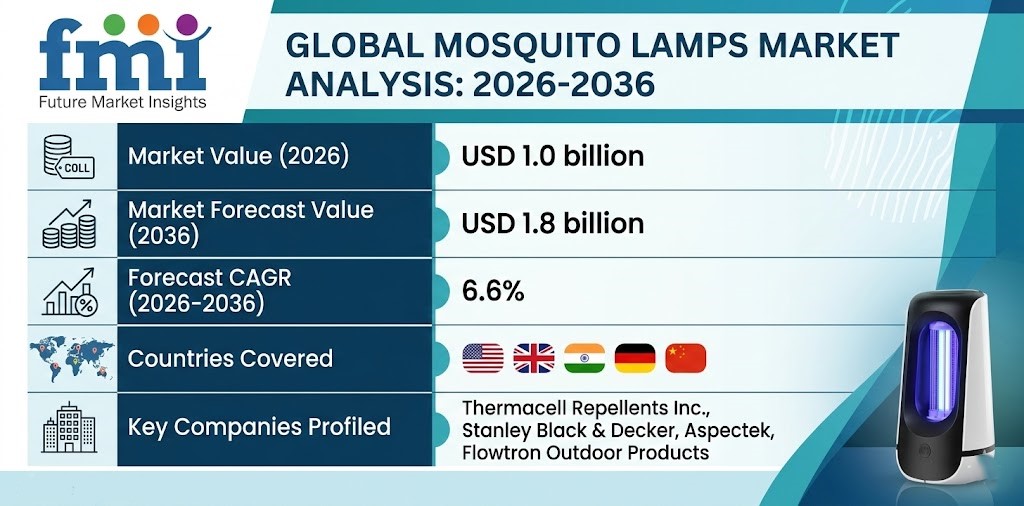
NEWARK, DE, UNITED STATES, February 27, 2026 /EINPresswire.com/ -- The global mosquito lamps market is projected to grow steadily over the next decade, expanding from USD 1.0 billion in 2026 to USD 1.8 billion by 2036, registering a CAGR of 6.6%. According to the latest analysis by Future Market Insights (FMI), growth is fueled by increasing incidence of vector-borne diseases, rising urban density, and consumer preference for non-toxic pest control alternatives.
As dengue and malaria cases remain prevalent across tropical and subtropical regions—highlighted by data from the World Health Organization—households and commercial property owners are prioritizing preventative, chemical-free mosquito control solutions. Modern mosquito lamps are evolving from traditional electric “zappers” into integrated UV-based insect-light systems designed for residential patios, hospitality venues, food processing units, and recreational environments.
Mosquito Lamps Market Snapshot (2026–2036)
• Market size in 2026: USD 1.0 billion
• Market size in 2036: USD 1.8 billion
• CAGR (2026–2036): 6.6%
• Leading product type: Electric mosquito lamps (~46% share)
• Leading distribution channel: Online retail (~41% share)
• Key growth regions: Asia Pacific, North America, Europe
• Fastest-growing countries: India, China, United States, Germany, United Kingdom
Request For Sample Report | Customize Report |purchase Full Report - https://www.futuremarketinsights.com/reports/sample/rep-gb-7885
Market Momentum
The mosquito lamps market, having crossed USD 0.9 billion in 2025, enters 2026 with strong consumer momentum. By 2031, expanding urban housing formats, outdoor leisure trends, and growing awareness around vector-borne illnesses are expected to push market valuation significantly upward.
Between 2031 and 2036, adoption accelerates further as manufacturers introduce longer-life UV LED arrays, solar-assisted charging systems, and app-enabled monitoring solutions. Hospitality chains, schools, clinics, and outdoor recreational facilities increasingly deploy mosquito lamps as part of integrated hygiene and contamination-prevention strategies. By 2036, the market is projected to reach USD 1.8 billion, sustaining a 6.6% CAGR over the decade.
Why the Market Is Growing
Demand for mosquito lamps is rising due to their ability to provide non-chemical insect control while supporting safe, low-maintenance operation. Growing regulatory scrutiny around chemical repellents by agencies such as the United States Environmental Protection Agency and evolving biocidal product standards in Europe are encouraging consumers to explore electric alternatives.
Urban apartment living, shrinking ventilation spaces, and extended evening outdoor usage patterns increase reliance on quiet, refill-free mosquito control devices. Solar-powered and battery-operated configurations further expand usability in regions with limited grid reliability.
In addition, hospitality and food-processing facilities are deploying monitored insect-light systems to meet hygiene audit standards, reinforcing demand for certified, performance-verified equipment.
Segment Spotlight
Product Type: Electric Mosquito Lamps Lead with ~46% Share
Electric mosquito lamps dominate due to consistent indoor and semi-outdoor usability, cost efficiency, and widespread retail availability. Solar-powered units are gaining traction in off-grid and eco-conscious segments, while portable battery-operated devices support camping and recreational use.
Distribution Channel: Online Retail Anchors Sales (~41% Share)
Online platforms lead sales, offering detailed coverage specifications, power consumption metrics, and verified customer reviews. Seasonal promotional campaigns—particularly pre-monsoon cycles in Asia—help brands capture early demand spikes and drive bundled accessory sales.
Regional Growth: Asia Pacific, North America, and Europe Drive Expansion
Asia Pacific remains the fastest-growing region, with India and China leading due to higher dengue exposure, dense urban housing, and expanding e-commerce penetration.
North America experiences strong growth supported by outdoor living trends and regulatory awareness regarding chemical pest control products.
Europe demonstrates steady expansion, with sustainability priorities encouraging lower-energy UV LED designs and recyclable housing materials aligned with European regulatory frameworks.
Drivers, Opportunities, Trends, Challenges
Drivers:
• Rising incidence of dengue and malaria
• Growth in outdoor leisure and patio living
• Increasing preference for chemical-free solutions
Opportunities:
• Smart-enabled mosquito lamps with app integration
• Solar-assisted and rechargeable battery models
• Institutional contracts in hospitality, healthcare, and education sectors
Trends:
• UV wavelength calibration for improved capture rates
• Integrated lighting + pest control designs
• Verified coverage zone engineering for premium positioning
Challenges:
• Performance variability across mosquito species
• Electrical safety compliance costs
• Low-quality imports affecting consumer trust
Competitive Landscape
The mosquito lamps market features a competitive mix of established outdoor equipment brands and regional manufacturers. Companies differentiate through coverage validation, UV spectrum tuning, enclosure safety design, and extended battery life.
Leading players include:
• Thermacell Repellents, Inc.
• Stanley Black & Decker
• Woodstream Corporation
• Aspectek
• Flowtron Outdoor Products
• Gardner Fly Light Co.
• Summit Responsible Solutions
Recent developments include the launch of advanced rechargeable mosquito repellers by Thermacell and expanded hospitality partnerships aimed at increasing institutional penetration.
Manufacturers are strengthening supply chain control over UV modules, battery systems, and casing materials to maintain pricing stability and improve durability standards across climate conditions.
Frequently Asked Questions (FAQs)
1. What is the projected size of the mosquito lamps market by 2036?
The market is expected to reach USD 1.8 billion by 2036, growing at a CAGR of 6.6% from 2026.
2. What is driving growth in the mosquito lamps market?
Rising cases of dengue and malaria, increasing demand for chemical-free pest control, and growth in outdoor living spaces are key drivers.
3. Which product segment leads the market?
Electric mosquito lamps lead the market, accounting for approximately 46% share in 2026.
4. Which region is growing the fastest?
Asia Pacific is the fastest-growing region, led by strong demand in India and China.
5. Who are the key players in the mosquito lamps market?
Major companies include Thermacell Repellents, Inc., Stanley Black & Decker, Woodstream Corporation, Aspectek, and Flowtron Outdoor Products.
Why FMI: https://www.futuremarketinsights.com/why-fmi
Explore more research reports by FMI
Hydroxytyrosol for Skin Health Market:https://www.futuremarketinsights.com/reports/hydroxytyrosol-for-skin-health-market
Car Air Purifier Market:https://www.futuremarketinsights.com/reports/car-air-purifier-market
Turmeric-Infused Actives Market:https://www.futuremarketinsights.com/reports/turmeric-infused-actives-market
About Future Market Insights (FMI)
Future Market Insights, Inc. (FMI) is an ESOMAR-certified, ISO 9001:2015 market research and consulting organization, trusted by Fortune 500 clients and global enterprises. With operations in the U.S., UK, India, and Dubai, FMI provides data-backed insights and strategic intelligence across 30+ industries and 1200 markets worldwide.
Sudip Saha
Future Market Insights Inc.
+1 347-918-3531
email us here
Legal Disclaimer:
EIN Presswire provides this news content "as is" without warranty of any kind. We do not accept any responsibility or liability for the accuracy, content, images, videos, licenses, completeness, legality, or reliability of the information contained in this article. If you have any complaints or copyright issues related to this article, kindly contact the author above.
