

Genomic Risk Stratification Test Market Size, Share, Forecast: Growth Segments, Value Chain Insight, Opportunity Mapping
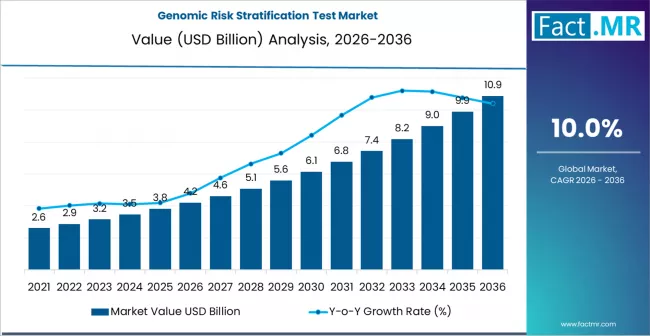
Genomic Risk Stratification Test Market Size and Share Forecast Outlook 2026 to 2036
ROCKVILLE, MD, UNITED STATES, January 21, 2026 /EINPresswire.com/ -- The Genomic Risk Stratification Test Market is projected to experience substantial growth over the next decade as healthcare providers and diagnostic laboratories increasingly adopt precision medicine tools for early disease detection and personalized treatment planning. The market is expected to grow from approximately USD 4.5 billion in 2026 to around USD 10.2 billion by 2036, representing a compound annual growth rate (CAGR) of roughly 8.5% over the forecast period.Key Takeaways from Genomic Risk Stratification Test Market:
Genomic Risk Stratification Test Market Value (2026): USD 4.2 billion
Genomic Risk Stratification Test Market Forecast Value (2036): USD 10.9 billion
Genomic Risk Stratification Test Market Forecast CAGR: 10.0%
Leading Product Category in Genomic Risk Stratification Test Market: NGS-based Tests (42.0%)
Key Growth Regions in Genomic Risk Stratification Test Market: North America, Europe, East Asia
Key Players in Genomic Risk Stratification Test Market: Illumina, F. Hoffmann-La Roche, Thermo Fisher Scientific, QIAGEN, Agilent Technologies
Request for Sample Report | Customize Report | Purchase Full Report – https://www.factmr.com/connectus/sample?flag=S&rep_id=13755
Market Overview:
Who is driving the market?
The market is driven by diagnostic laboratories, biotechnology firms, genomic testing companies, and healthcare providers offering genomic-based risk assessment services. These stakeholders collaborate to provide comprehensive solutions for disease risk stratification, particularly in oncology, cardiology, and chronic disease management.
What are genomic risk stratification tests?
Genomic risk stratification tests are molecular diagnostic tools that analyze genetic information to assess an individual’s susceptibility to specific diseases. These tests enable early identification of high-risk individuals, guide preventive strategies, and assist clinicians in personalizing treatment plans. Applications include cancer risk assessment, cardiovascular disease prediction, and metabolic disorder evaluation.
When is the market expected to grow?
The primary growth period spans 2026 to 2036, during which increasing integration of genomics into clinical practice and rising demand for personalized healthcare solutions are expected to drive market adoption.
Where is the market expanding?
Market growth is global, with high adoption in North America, Europe, Asia Pacific, Latin America, and the Middle East & Africa. North America remains the largest market due to advanced healthcare infrastructure, widespread awareness, and early adoption of genomic technologies. Asia Pacific is emerging as a fast-growing market due to rising healthcare investments and expanding genomic research initiatives.
Why is the market growing?
Several key factors are driving growth:
Rising focus on personalized medicine and preventive healthcare
Increasing prevalence of chronic diseases and cancer globally
Advances in genomic technologies, bioinformatics, and high-throughput sequencing
Growing awareness among clinicians and patients regarding early risk detection and tailored interventions
How is the market evolving?
The market is evolving with innovations in next-generation sequencing, bioinformatics analysis, and multi-gene panel testing, allowing for faster, more accurate, and cost-effective genomic risk assessments. Partnerships between technology providers, healthcare institutions, and research organizations are also accelerating adoption and application development.
Segment Analysis and Application Insights
Test Types
Genomic risk stratification tests include oncology-focused panels, cardiology risk panels, hereditary disorder panels, and multi-disease risk panels. Oncology testing dominates the market due to high demand for early cancer detection and personalized treatment planning.
End-Use Applications
Key end-use applications include hospitals, diagnostic laboratories, research institutes, and specialized genomic clinics. Hospitals and diagnostic laboratories represent the largest segment as they integrate genomic testing into patient care pathways.
Market Drivers and Trends
Drivers include the growing demand for precision medicine, technological advancements in genomic sequencing, and regulatory support for molecular diagnostics. Trends include the development of comprehensive multi-gene panels and integration of artificial intelligence and machine learning in genomic data interpretation for improved clinical decision-making.
Regional Growth Highlights
North America: Strong adoption due to established healthcare infrastructure, high awareness, and extensive genomic research
Europe: Growth supported by precision medicine initiatives, government funding, and insurance coverage for genomic testing
Asia Pacific: Rapid expansion driven by rising healthcare expenditure, growing population awareness, and increased genomic research
Latin America and Middle East & Africa: Gradual growth as healthcare infrastructure develops and access to advanced diagnostic solutions improves
Competitive Landscape
The market is highly competitive, featuring leading diagnostic companies, biotechnology firms, and specialized genomic test providers. Companies differentiate through innovative test offerings, advanced bioinformatics platforms, clinical validation, and strategic collaborations with healthcare providers. Key players focus on expanding their portfolios and geographical reach to capture growth opportunities in emerging markets.
Market Outlook
The Genomic Risk Stratification Test Market offers substantial opportunities for diagnostic laboratories, healthcare providers, and biotechnology companies. As precision medicine adoption accelerates and demand for early disease detection increases, genomic risk stratification tests will continue to play a critical role in personalized healthcare strategies through 2036. Continuous innovation, regulatory support, and increased awareness among clinicians and patients will be essential to sustaining long-term market growth.
Browse Full Report : https://www.factmr.com/report/genomic-risk-stratification-test-market
To View Related Report :
Metagenomics Market: https://www.factmr.com/report/metagenomics-market
Metagenomic Sequencing Market: https://www.factmr.com/report/metagenomic-sequencing-market
Retail Genomics Market: https://www.factmr.com/report/retail-genomics-market
Cancer Genomic Testing Market: https://www.factmr.com/report/3999/cancer-genomic-testing-market
S. N. Jha
Fact.MR
+1 628-251-1583
email us here
Legal Disclaimer:
EIN Presswire provides this news content "as is" without warranty of any kind. We do not accept any responsibility or liability for the accuracy, content, images, videos, licenses, completeness, legality, or reliability of the information contained in this article. If you have any complaints or copyright issues related to this article, kindly contact the author above.
