

Breast Cancer Therapeutics Market is expected to reach US$ 72.05 Billion by 2033 | DataM Intelligence
Breast Cancer Therapeutics Market
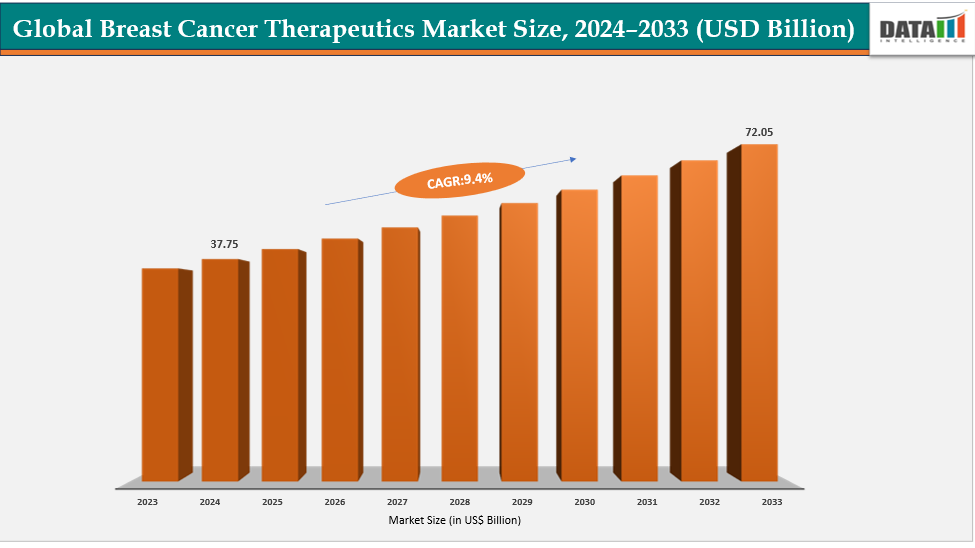
The Global Breast Cancer Therapeutics Market is expected to reach at a CAGR of 9.4% during the forecast period 2025-2033.
The Breast Cancer Therapeutics Market is driven by rising incidence, innovation in targeted and immunotherapies, and expanding access to advanced oncology care worldwide.”
AUSTIN, TX, UNITED STATES, January 21, 2026 /EINPresswire.com/ -- Market Overview:— DataM Intelligence
The Breast Cancer Therapeutics Market represents one of the most dynamic and innovation-driven segments within the global oncology industry. It encompasses a broad range of treatment modalities, including chemotherapy, hormone therapy, targeted therapy, immunotherapy, and emerging gene-based approaches, all aimed at improving survival outcomes and quality of life for patients. Rising incidence of breast cancer, improved diagnostic rates, and expanding awareness programs are driving earlier detection and higher treatment uptake. The market is also benefiting from continuous advancements in precision medicine, which allow therapies to be tailored to tumor subtypes such as HER2-positive, hormone receptor-positive, and triple-negative breast cancer, thereby enhancing treatment efficacy and reducing unnecessary toxicity.
To Download Sample Report Here: https://www.datamintelligence.com/download-sample/breast-cancer-therapeutics-market
According to DataM Intelligence, The Global Breast Cancer Therapeutics Market was valued at approximately USD 37.75 billion in 2024 and is projected to reach around USD 72.05 billion by 2033, growing at a compound annual growth rate (CAGR) of about 9.4% during the forecast period. Key growth drivers include the increasing prevalence of breast cancer worldwide, expanding geriatric populations, rising adoption of biologics and targeted drugs, and strong investment in oncology research and development. Targeted therapy currently represents the leading treatment segment due to its higher response rates and lower systemic side effects compared to conventional chemotherapy. Geographically, North America dominates the market, supported by advanced healthcare infrastructure, favorable reimbursement frameworks, high awareness levels, and rapid adoption of novel therapies, while Asia-Pacific is emerging as the fastest-growing region due to improving healthcare access and rising patient pools.
Key Highlights from the Report:
The Global Breast Cancer Therapeutics Market is expected to register robust growth driven by rising incidence and technological innovation.
Targeted therapies account for the largest revenue share owing to precision treatment and improved clinical outcomes.
Hospital pharmacies remain the primary distribution channel due to high patient inflow and complex treatment regimens.
North America leads the market, while Asia-Pacific is projected to witness the highest growth rate.
Increasing approvals of monoclonal antibodies and antibody-drug conjugates are reshaping the treatment landscape.
Strategic collaborations between pharmaceutical companies and research institutes are accelerating drug development.
Market Segmentation:
The Breast Cancer Therapeutics Market is segmented based on therapy type, cancer subtype, distribution channel, and end-user. By therapy type, the market includes chemotherapy, hormone therapy, targeted therapy, immunotherapy, and combination therapies. Chemotherapy remains widely used, particularly in advanced and metastatic cases; however, targeted therapy has gained significant traction due to its ability to selectively inhibit cancer-driving pathways such as HER2, CDK4/6, and PI3K. Hormone therapy continues to play a critical role in estrogen receptor-positive breast cancer, which accounts for a substantial proportion of diagnosed cases globally.
Segmentation by cancer subtype further refines treatment approaches into HER2-positive, hormone receptor-positive, and triple-negative breast cancer. HER2-positive and hormone receptor-positive segments have benefited the most from targeted and endocrine therapies, while triple-negative breast cancer is witnessing increased research focus with the introduction of immunotherapy and novel antibody-drug conjugates. In terms of distribution channels, hospital pharmacies dominate due to the complex administration protocols and the need for specialized oncology care. Retail and online pharmacies are gradually expanding, particularly for oral targeted and hormonal agents. End-users primarily include hospitals, specialty clinics, and cancer research centers, with hospitals accounting for the largest share owing to integrated diagnostic and treatment facilities.
Speak to Our Analyst and Get Customization in the report as per your requirements: https://www.datamintelligence.com/customize/breast-cancer-therapeutics-market
Regional Insights:
North America holds the largest share of the global breast cancer therapeutics market, supported by a high prevalence of the disease, well-established screening programs, and rapid adoption of innovative drugs. The presence of leading pharmaceutical companies, strong clinical trial activity, and favorable reimbursement policies further strengthen the region’s market position. The United States, in particular, contributes significantly due to early regulatory approvals and extensive use of biologics and precision therapies.
Europe follows closely, driven by increasing awareness, government-supported cancer control programs, and expanding access to advanced treatment options. Countries such as Germany, the United Kingdom, and France are at the forefront of adopting novel targeted therapies and immuno-oncology drugs. Meanwhile, the Asia-Pacific region is experiencing the fastest growth, fueled by rising incidence rates, improving healthcare infrastructure, and growing investments in oncology research. China, India, and Japan are emerging as key markets, supported by expanding patient populations and increasing availability of cost-effective biosimilars. Latin America and the Middle East & Africa are also witnessing gradual market expansion as healthcare access improves and awareness initiatives gain momentum.
Market Dynamics:
Market Drivers
The primary driver of the Breast Cancer Therapeutics Market is the rising global incidence of breast cancer, which continues to increase due to lifestyle changes, urbanization, and aging populations. Technological advancements in molecular diagnostics and genomic profiling have enabled the development of targeted and personalized therapies, significantly improving survival rates. Growing healthcare expenditure, supportive reimbursement frameworks in developed economies, and increasing clinical research activity are further propelling market growth. Additionally, strong pipelines of novel drugs, including antibody-drug conjugates and immune checkpoint inhibitors, are expanding treatment options for patients with resistant or advanced disease.
Market Restraints
Despite strong growth prospects, the market faces challenges such as the high cost of innovative therapies, which can limit access in low- and middle-income countries. Stringent regulatory requirements and lengthy approval processes may delay the commercialization of new drugs. Moreover, adverse effects associated with certain treatments and the development of drug resistance in some patient populations can hinder long-term therapy effectiveness and impact patient adherence.
Market Opportunities
The increasing focus on personalized medicine presents significant opportunities for market players. Advances in biomarker discovery, companion diagnostics, and artificial intelligence-driven drug development are expected to enhance treatment precision and outcomes. Emerging markets offer substantial growth potential due to expanding healthcare infrastructure, rising awareness, and government initiatives to improve cancer care. The development of biosimilars and cost-effective targeted therapies is also expected to broaden patient access and drive market penetration.
Looking For Full Report? Get it Here: https://www.datamintelligence.com/buy-now-page?report=breast-cancer-therapeutics-market
Frequently Asked Questions (FAQs):
How Big is the Global Breast Cancer Therapeutics Market?
Who are the Key Players in the Global Breast Cancer Therapeutics Market?
What is the Projected Growth Rate of the Breast Cancer Therapeutics Market?
What is the Market Forecast for 2032?
Which Region is Estimated to Dominate the Breast Cancer Therapeutics Industry through the Forecast Period?
Market Companies:
Genentech USA, Inc.
Pfizer Inc.
Novartis Pharmaceuticals Inc.
AstraZeneca
Eli Lilly Inc.
Bristol-Myers Squibb Company
Merck & Co., Inc.
DePuy Synthes
GSK
Stemline Therapeutics, Inc.
Recent Developments:
United States:
December 2025: Biopharma leaders announced expanded access programs for next-generation ADCs in triple-negative breast cancer, addressing unmet needs in late-stage disease.
November 2025: A major phase III trial reported positive outcomes for an oral SERD combined with CDK4/6 inhibitors, showing improved progression-free survival in HR-positive advanced cases.
October 2025: The FDA granted accelerated approval to a novel bispecific antibody targeting HER2-low metastatic breast cancer, enhancing options for patients post-standard therapies.
Japan:
December 2025: Daiichi Sankyo expanded its Trop2-directed ADC approval to include earlier lines of therapy for HR-positive, HER2-negative advanced breast cancer.
November 2025: A collaborative study revealed promising results from genomic profiling initiatives, enabling personalized targeted therapies in over 20% more patients nationwide.
October 2025: Japan's PMDA approved an updated immunotherapy regimen for early-stage HER2-positive breast cancer, integrating neoadjuvant and adjuvant strategies for better efficacy.
Unlock 360° Market Intelligence with DataM Subscription Services: https://www.datamintelligence.com/reports-subscription
Conclusion:
The Breast Cancer Therapeutics Market is undergoing rapid transformation driven by scientific innovation, rising disease burden, and a growing emphasis on personalized medicine. With strong growth projected through 2032, the market is poised to benefit from continuous advancements in targeted therapy, immuno-oncology, and biomarker-driven treatment strategies. While challenges such as high treatment costs and regulatory complexities persist, expanding healthcare access, robust research pipelines, and increasing awareness are creating a favorable environment for sustained market expansion. As leading pharmaceutical companies and research institutions continue to invest in innovative solutions, the future of breast cancer treatment promises improved outcomes and broader access for patients worldwide.
Related Reports:
Breast Cancer Drugs Market
Breast Cancer Treatment Market
Sai Kiran
DataM Intelligence 4Market Research
+1 877-441-4866
Sai.k@datamintelligence.com
Visit us on social media:
LinkedIn
X
Legal Disclaimer:
EIN Presswire provides this news content "as is" without warranty of any kind. We do not accept any responsibility or liability for the accuracy, content, images, videos, licenses, completeness, legality, or reliability of the information contained in this article. If you have any complaints or copyright issues related to this article, kindly contact the author above.
