

Percutaneous Vessel Closure Devices Market Projected to Reach USD 10.6 Billion by 2036 as Minimally Interventions Surge
Percutaneous Vessel Closure Devices Market
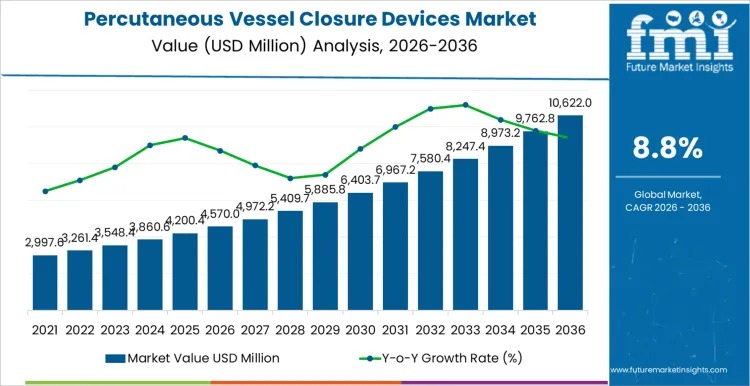
The percutaneous vessel closure devices market is projected to grow from USD 4,570.0 million in 2026 to USD 10,622.0 million by 2036, at a CAGR of 8.8%.
NEWARK, DE, UNITED STATES, January 16, 2026 /EINPresswire.com/ -- The global percutaneous vessel closure devices market is entering a decade of significant transformation, driven by a paradigm shift in interventional cardiology and endovascular care. New market data indicates the industry is poised to be valued at USD 4,570.0 million in 2026, with a projected climb to USD 10,622.0 million by 2036. This trajectory represents a robust CAGR of 8.8% over the forecast period.
The steady expansion of this sector reflects a critical move toward procedural safety and recovery efficiency. As healthcare systems globally prioritize early ambulation and same-day discharge pathways, the reliance on automated vessel closure—which replaces traditional, time-consuming manual compression—has transitioned from an optional convenience to a clinical necessity.
Redefining Post-Procedural Recovery and Hemostasis
Modern interventional medicine is increasingly defined by "large-bore" access procedures, including structural heart repairs and complex peripheral interventions. These sophisticated treatments require reliable arterial closure that can withstand varied patient anatomies and anticoagulation profiles. Percutaneous vessel closure devices address these challenges by providing consistent, software-mapped, or mechanical sealing of access sites.
Request For Sample Report | Customize Report |purchase Full Report - https://www.futuremarketinsights.com/reports/sample/rep-gb-31423
Key Drivers of Market Adoption:
• Enhanced Clinical Outcomes: Devices significantly reduce access-site complications, such as hematomas and pseudoaneurysms, compared to manual pressure.
• Operational Efficiency: By shortening post-procedure monitoring time, hospitals can stabilize workflows and increase procedural throughput in high-volume catheterization labs (cath labs).
• Patient Ambulation: Accelerated hemostasis allows patients to walk sooner, facilitating same-day discharge and reducing the burden on nursing staff.
• Material Innovation: The integration of bioabsorbable components and refined deployment mechanisms is addressing long-term concerns regarding vessel integrity and foreign body responses.
Market Segmentation: Suture-Based Systems and Cardiology Demand
The industry’s technological landscape is shaped by a preference for mechanical reliability and rapid deployment.
• Leading Product Type: Suture-based closure devices hold the largest share at 34.0%. Their dominance is attributed to their proven efficacy in providing secure, predictable closure in procedures requiring larger sheaths.
• Dominant Application: Interventional cardiology represents 38.0% of the market, fueled by high volumes of coronary angiography and percutaneous coronary interventions (PCI).
• Primary End Users: Hospitals and cath labs account for 48.0% of utilization, reflecting the concentration of high-acuity interventional care in acute settings.
Regional Growth Hubs: India and Brazil Lead Global Modernization
While the United States and Germany remain cornerstones of the market due to mature infrastructure and reimbursement stability, emerging economies are experiencing the fastest acceleration as they modernize their cardiovascular care networks.
• India (11.3% CAGR): Rapid growth is supported by an expansion in private cardiac centers and a high volume of femoral access procedures requiring efficient bed utilization.
• Brazil (10.8% CAGR): Modernization of public and private cath labs is focused on reducing recovery times and post-procedure complications.
• China (10.4% CAGR): Momentum is sustained by the availability of cost-competitive domestic devices and national clinical guidance encouraging standardized post-procedure care.
• United States (7.2% CAGR): Expansion is driven by the rise of large-bore structural heart procedures and a shift toward ambulatory surgical center (ASC) models.
Strategic Competitive Landscape
The global demand for percutaneous vessel closure is supported by a tier of specialized medical technology leaders. Abbott maintains a leading position through widely adopted platforms backed by extensive clinical evidence. Terumo competes with designs emphasizing procedural simplicity, while Cardinal Health, Haemonetics, and Merit Medical provide essential closure solutions integrated within broad interventional supply chains.
Competitive differentiation in 2026 is increasingly centered on "closure reliability" in complex cases and the ability to integrate with digital facility management tools to track patient recovery milestones.
About the Percutaneous Vessel Closure Devices Market Report
This analysis, last updated on January 15, 2026, provides a comprehensive overview of the global vascular access management landscape. It evaluates device types, clinical applications, and end-user behavior across 40+ countries to offer a detailed roadmap of the sector’s evolution through 2036.
Similar Industry Reports
Vessel-sealing Devices Market
https://www.futuremarketinsights.com/reports/vessel-sealing-devices-market
Heart Closure Devices Market
https://www.futuremarketinsights.com/reports/heart-closure-devices-market
Vascular Closure Devices Market
https://www.futuremarketinsights.com/reports/vascular-closure-devices-market
Sudip Saha
Future Market Insights Inc.
+ +1 347-918-3531
email us here
Legal Disclaimer:
EIN Presswire provides this news content "as is" without warranty of any kind. We do not accept any responsibility or liability for the accuracy, content, images, videos, licenses, completeness, legality, or reliability of the information contained in this article. If you have any complaints or copyright issues related to this article, kindly contact the author above.
